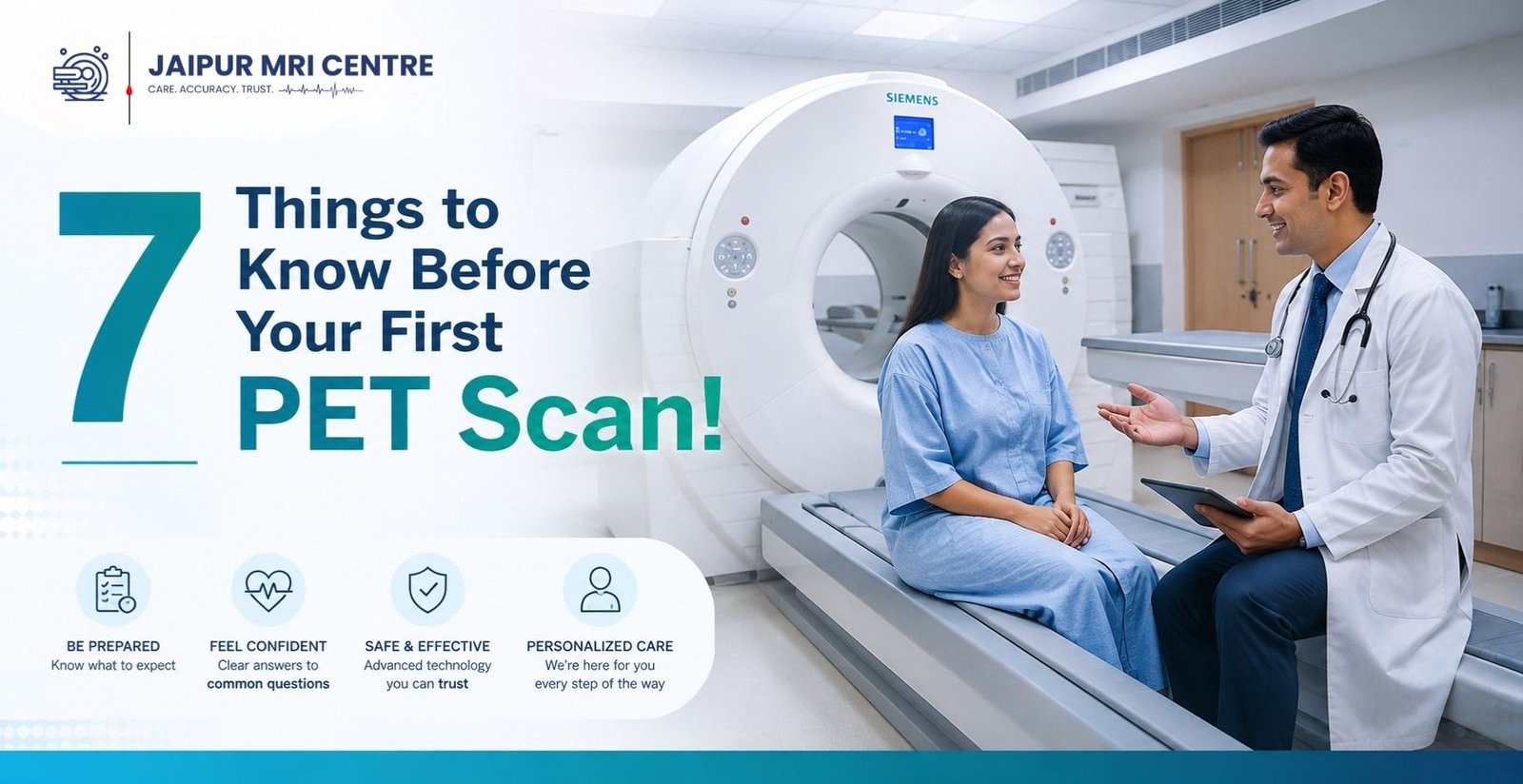
If you are getting a PET scan in Jaipur for the first time, you may have questions. What is the proper diet? Are you able to take medications? Does the scan hurt? What’s the time limit? What does the scan involve?
This is an advanced imaging test which is used to examine the body’s tissues and organs to help doctors understand how these are functioning, rather than just their structure. Applied in cancer care to identify abnormal activity, to check if there is any spread of cancer, to check how well the treatment is working, and to assess for recurrence of cancer.
The procedure is relatively simple, but good preparation makes for good results. Before your first PET scan, here are 7 important things to know and also where you can easily book your appointment.
| Question | Answer |
|---|---|
| Test Name | PET CT Scan |
| Purpose | Evaluate metabolic activity |
| Common Tracer | FDG |
| Duration | Around 2–3 hours including preparation |
| Pain Level | Usually painless |
| Used For | Cancer evaluation, treatment monitoring |
You must understand why your doctor recommends a PET scan. Unlike a standard X-ray, ultrasound, CT scan or MRI, a PET scan uses a small amount of radioactive tracer, commonly FDG (fluorodeoxyglucose), to evaluate metabolic activity inside tissues.
A PET scan in Jaipur can provide information about the body’s metabolic activity, while many imaging tests only show the structure of the body. FDG (fluorodeoxyglucose), which is a radioactive glucose-like substance, is often used with PET scans because cancer cells typically consume more glucose than normal cells.
The scan may assist doctors to:
PET is often used in conjunction with CT to form a PET/CT scan. The CT gives detailed anatomical information, and the PET gives information on metabolic activity. The combination of the two can assist doctors to determine both the location and activity of an abnormality.
Remember, higher blood levels of FDG do not necessarily indicate cancer. However, the increased uptake may be due to infection and inflammation, so the results of PET imaging must be compared with your medical history and other tests.
The FDG PET-CT scan may require that the patient fast for a number of hours prior to the scan in many cases. Timing of the fast could vary with the protocol of the imaging centre where we make our PET scanning appointment, so please check with the instructions of the diagnostic centre that you choose.
The tracer used in an FDG PET CT scan is similar to glucose. If there is any change in food consumption before the scan, it may affect the blood glucose and insulin levels. This could impact the distribution of the tracer in the body and may lessen the quality or usefulness of the scan.
Fasting means that you can usually drink plain water during this time, except as directed otherwise by your imaging centre. Do not eat or drink any sugary drinks unless your medical team says it is OK to do so.
Please check with your imaging centre before eating gum. It may be advised to avoid it at some of our partner centres in Jaipur due to the muscle stimulation it brings and the possibility of tracer distribution.
The best way to prepare would be to follow the exact instructions given by your PET facility.
In people who are having an FDG PET scan, strict glucose control is especially crucial. Sometimes, the medical staff will test the blood glucose level before giving the tracer. If it is too high, the scan may not be as useful, as there is competing uptake of glucose and FDG.
This is particularly true of diabetics. Never alter or discontinue diabetic medication without consulting your doctor prior to a PET scan. Rather, inform the diagnostic centre in Jaipur ahead of time that you have diabetes and share details of diabetes medications and typical treatment.
The diagnostic centre where your appointment is booked might provide you with instructions on:
These steps may help keep your blood sugar level from getting too high or too low during your appointment.
Let the medical team know about any significant medical issues and medications prior to your scan. This is especially beneficial if you are:
It is also important to note if you’ve ever had a reaction to any contrast material if you’re having a PET/CT with contrast given.
Don’t assume that you need to stop your regular medicines. Numerous medicines can be continued as usual, but some medicines and illnesses may need special preparation. Your PET centre will let you know what to do depending on the type of scan you have.
Exercise might surprise you – it can impact a PET scan. The metabolism of glucose in the muscles can be stimulated by vigorous exercise prior to an FDG PET scan. Active muscles can take up more tracer (FDG) since it resembles glucose.
This can make the pictures more difficult to interpret. Therefore, patients may be told to refrain from strenuous activity for about 24 hours prior to an FDG PET scan, depending on the protocol in the PET centre.
So, it’s best not to do any of the following:
Generally no problem with normal light day-to-day activities, but see the centre’s instructions.
Knowing what to expect during your first PET scan may make the experience helpful if you are a bit nervous.
Step 1: Registration and preparation
Once you reach the facility, staff may verify medical history, medications, the patient’s fast and blood sugar.
Step 2: Tracer injection
A small amount of radioactive tracer (usually FDG) is given intravenously. The actual injection is like having blood drawn or a routine IV injection.
Step 3: Resting period
This is an important component of the test. Once you get the tracer, you will typically lie down and rest quietly for about 45-60 minutes, but it varies.
In this time, you might be asked to relax and not move or speak unnecessarily, since movement and speech can influence the distribution of the tracers.
Step 4: The scan
This will involve lying on a slow-moving scanning table that will pass through the PET-CT scanner.
The imaging part of the PET scan appointment will last about 20–30 minutes, but the entire appointment may be longer due to preparation time and the time required for the tracer to enter the body.
The scanning process is not likely to be painful. You might need a second injection if you need contrast for the CT part of the scan. A small number of people feel a warm sensation or odd taste after the contrast is injected.
After the scan, most people should be able to resume normal activities unless directed otherwise by their doctors.
After the exam, you will generally be asked to drink lots of water. This allows the radioactive tracer to be excreted by the body in urine. Radiation emitted from the tracer diminishes with time, and the material is progressively excreted from the body.
Your imaging centre may have guidelines for a brief period following the scan for close contact with pregnant women or young children. Familiarise yourself with the recommendations from your facility as there may be variations in recommendations depending on the tracer and examination.
A picture is taken by a nuclear medicine doctor or radiologist who will report the findings to your doctor.
The technician who is doing the scan usually does not provide a result immediately. The meaning of the findings in the context of your symptoms, medical history, blood tests, and other imaging will be explained to you by your doctor.
Use this checklist to find out what to wear to a PET scan.
Depending on the scanner and what examination you are having, you may be given more instructions by your imaging centre.
A PET scan is not painful to the majority of people. The only discomfort is likely to be from the needle used for the tracer injection. There is no pain involved in the scanning.
Some may not be comfortable just because they have to lie still on the scanner table. If you are afraid of being in enclosed areas, let them know in advance. They can explain the scanner and make you feel at ease.
No. This is a big misunderstanding.
A PET scan can detect regions of higher metabolic activity; however, there is no direct link between higher metabolic activity and cancer.
Increased FDG uptake can also occur in inflammatory/infective processes, healing tissue, and some normal tissue. Likewise, some cancers may have low FDG uptake, especially some of the slower-growing types or special types of cancer.
Thus, PET data are used in conjunction with other data to interpret the results. Sometimes, a biopsy will still be needed to make sure that a suspicious area is not cancer.
Tell your doctor and the PET centre if you are or think you could be carrying a baby. A PET scan exposes the body to ionising radiation, and the medical team will take into account whether the PET scan is required during pregnancy.
Let the diagnostic centre know if you are breastfeeding, too. You may be told certain information regarding breastfeeding after the exam based on the tracer you are having to perform.
It can be confusing to understand why your doctor may recommend several different scans.
Also check, MRI vs. CT Scan: Which One Do You Really Need?
The first PET scan might sound complicated, but the actual procedure is pretty simple. Following the instructions to prepare given by your imaging centre is the most important part.
Here are points to keep in mind:
PET scans can give useful information about the function of tissues and are a useful tool in the diagnosis and treatment of some diseases, including cancer. But the result of the PET scan should never be the only indicator. Your doctor will take it into account with your symptoms, exam, lab tests, and other imaging and biopsy results.
Include:
Although actual imaging usually takes around 20–30 minutes, the complete procedure and appointment may take approximately 2–3 hours due to preparation and tracer uptake time
Most FDG PET CT scans require fasting for at least 4-6 hours before the procedure. So from the last night you can eat whatever you want and after don’t take anything just take your ongoing medicines.
Looking for a PET CT scan facility in Jaipur? Jaipur MRI Centre helps you connect with suitable diagnostic centres and book your appointment easily.


Need Help