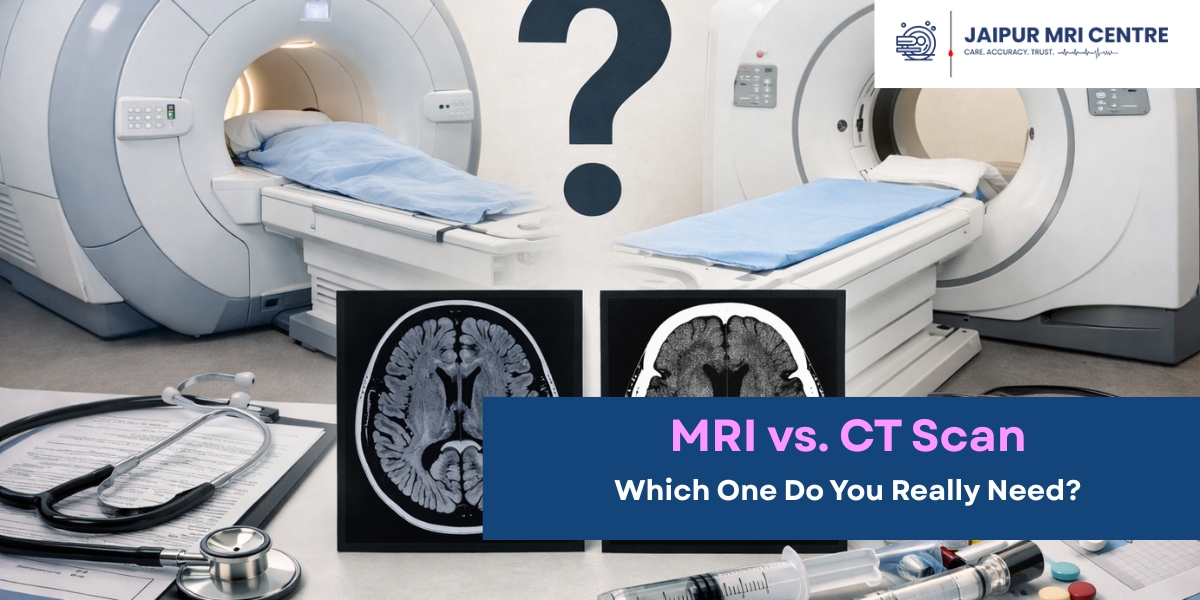
MRI and CT scans are two of the most commonly used imaging tests. Both help doctors look inside the body, but they work in different ways and are used for different medical needs. Knowing the difference can help patients feel more prepared when a doctor asks for one of these scans.
This is because with the knowledge of the contrast between MRI and CT scans, the patient can be much more confident and ready to take the test. In this blog, we shall describe how these scans operate and their main differences, how the doctors prescribe each of them and how you can book ONLINE appointment for these.

Need more help? Talk to a Jaipur MRI Centre Expert
 Get a Callback
One such advanced imaging method is an MRI (Magnetic Resonance Imaging) scan whereby strong magnetic fields and radio waves are deployed to create detailed images of the interior part of the body.
MRI does not utilize radiation as opposed to other imaging tests. Rather, it employs the magnetic energy to give the detailed images of organs, tissues, nerves, and muscles with a great degree of detail.
Generally in the diagnostic centres in Jaipur, the scans made by MRI are especially useful in the investigation of:
Due to the fact that MRI gives a very high resolution of soft tissues, physicians tend to order MRI when they want to have accurate diagnostic data.
Doctors often choose MRI when they need a detailed view of soft tissues or when a body structure is harder to assess on CT or plain X-ray. MRI is often used for:
MRI can take longer than CT and the machine can feel narrow for some people, but it often gives the detail needed for conditions linked to soft tissue. NHS guidance also points out that MRI appointments may involve contrast in some cases and often last from around 15 minutes to 1 hour.
A CT (Computed Tomography) scan involves the use of X-rays and computer technology in developing cross-sectional body images. It takes various X-ray images at varying angles and assembles them to create detailed images.
CT scans in Jaipur tend to be quicker than MRI scans and they are frequently employed in cases of emergency.
CT scans are usually recommended to physicians to identify:
Since the CT scans are based on the use of X-rays, they are associated with minimal radiation exposure, but the radiation employed is deemed to be safe as far as the diagnostic aspect is concerned.
The CT scans are done in cases in which the physicians require prompt findings as well as to perform tests on bones and internal trauma.
Common uses include:
Due to the rapidity and the abundance of CT scans, emergency departments often utilize them.
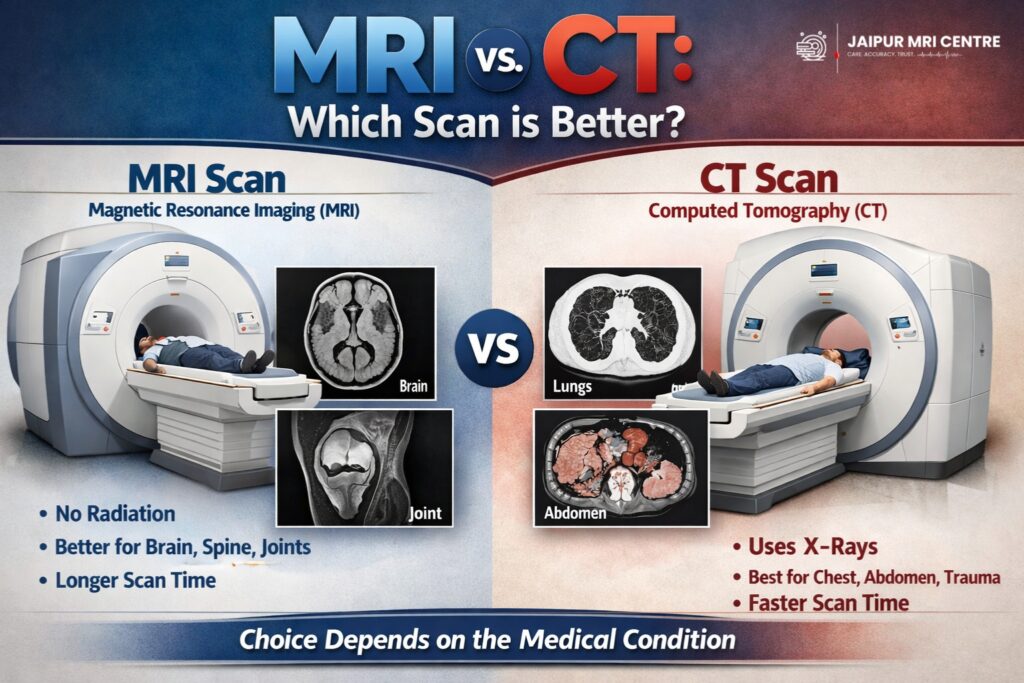
The question much posed by many patients concerns which is better, MRI or CT scan. The fact of the matter is that the two scans are used in different purposes.
MRI is superior when it comes to studying soft tissues, nerves, and organs, whereas CT scans prove superior in cases of bones and emergency tests.
The scan is selected by your doctor due to: Your symptoms, body part being examined, level of detail required and the urgency of diagnosis.
The reason is that the scan that is better is solely related to the medical condition under investigation.
| Feature | MRI Scan | CT Scan |
|---|---|---|
| Technology | Uses magnetic fields and radio waves | Uses X-ray radiation |
| Radiation | No ionizing radiation | Uses ionizing radiation |
| Best For | Soft tissues, brain, spine, joints, nerves | Bones, trauma, bleeding, chest and abdomen in urgent cases |
| Scan Time | 20–45 minutes | 5–10 minutes |
| Common Use | Ligament tears, spine issues, brain imaging | Fractures, trauma, internal bleeding, lung and abdominal assessment |

Don’t have a prescription? Consult a doctor online
For MRI:
For CT:
Tell the scan centre and your doctor if you are pregnant or might be pregnant. MRI and CT Scan in pregnancy is generally avoided unless medically needed.
Also check, How to Prepare for an MRI Scan: Complete Patient Guide!
Also, despite the fact that both MRI and CT scans are potent diagnostic methods, they operate differently and are applied with different purposes.
MRI scans involve magnetic fields and radio waves whereas CT scans involve X-ray radiations to generate images.
MRI images are highly detailed images of soft tissues such as brain, nerves, muscles and ligaments. Whereas, CT scans are more useful in the visualization of bones, fractures, and internal bleeding.
MRI scans can typically take 20-45 minutes depending on the area being investigated. CT scans are significantly faster in nature and usually require 5-10 minutes.
MRI scanning is non-radiative and CT scans involve low dose X-ray radiations.
CT scans are also used in emergencies like accidents or trauma cases due to their high level of speed. MRI scans are normally applied in cases where the diagnosis needs to be provided in form of a detailed image.
If your doctor has specifically requested a PET CT, don’t worry about long wait times. At Jaipur MRI Centre, we provide specialized PET CT Scan services with the same patient-first care and quick reporting you expect from our MRI team.
MRI safety screening for metal and implanted devices is a major part of the process. CT and MRI contrast also need care in some patients.
When your doctor has advised an MRI scan then you need to be careful to select a well-equipped and reliable diagnostic centre in order to get the right reading. JAIPUR MRI CENTRE is a renowned diagnostic centre in Jaipur, that is trusted for its advanced MRI imaging with modern technology and trained radiological team.
Whether you need a PET CT Scan or a specialized Brain MRI, our centre provides:
The centre specialises in providing dependable diagnostics as well as patient-centred services, whereby the patients are provided with the correct results that would aid the doctors in making the correct treatment decisions.
In conclusion, both the MRI and CT scan are a strong medical imaging instrument which assists the doctor to diagnose a broad spectrum of health disorders. CT is often chosen when speed matters or when doctors need to assess fractures, trauma, bleeding, or urgent chest and abdominal concerns.
Knowing the difference between MRI and CT can help patients feel more prepared before their test. The right scan is the one that best fits your medical need.
If your doctor has advised an MRI scan in Jaipur, book your appointment with a trusted diagnostic centre that focuses on accurate imaging, patient comfort, and timely reports.
Accuracy depends on the body part and the condition being checked. MRI does not use ionizing radiation, but it still has safety issues around metal implants, some devices, and contrast use in selected patients. CT uses ionizing radiation, and the risk should be kept in context rather than dismissed too casually
It is true that MRI is more accurate in detecting most soft tissue abnormalities, nerve disorders and brain disorders than CT scans.
Yes, MRI does not use ionizing radiation, while CT uses X-rays. That said, the safer and more useful test depends on your medical need, body part, and doctor’s judgment.
The average time of performing an MRI scan varies between 20 and 45 minutes, depending on the area of the body that the scan is conducted.
In Jaipur MRI Centre, you can get good MRI imaging and correct diagnostic reports.
Disclaimer: This blog is for informational purposes and should not replace professional medical advice. Please consult your doctor regarding any medical concerns or sedative options.
Get clear imaging and dependable reports from an experienced team.


Need Help

 +91 7976031157