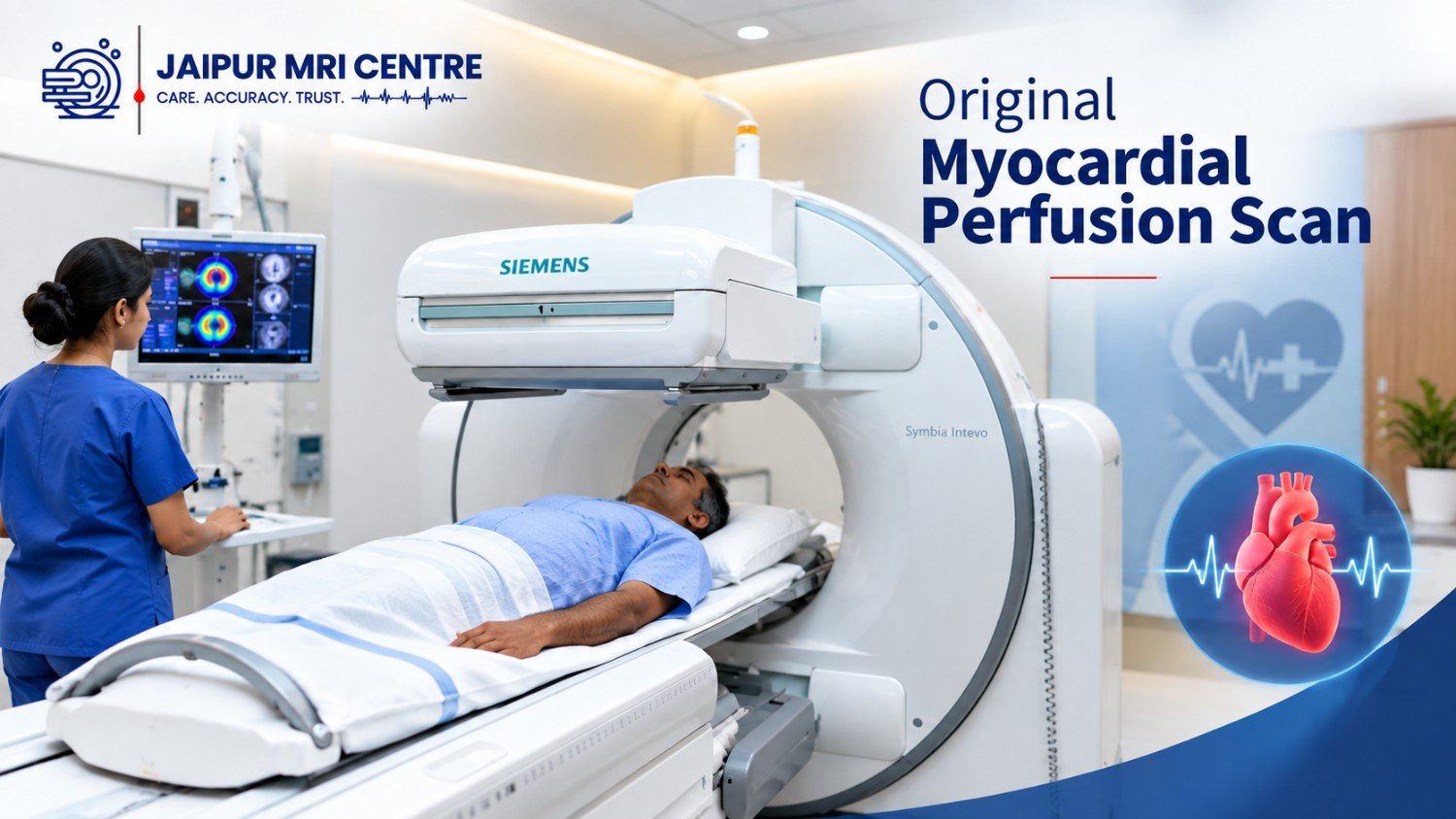
A precision diagnostic scan is of critical importance when considering persistent chest pain, shortness of breath that cannot be explained or possible blockages of the coronary arteries. Cardiac Perfusion Scan, also known as Myocardial Perfusion Scan (MPS) or a nuclear stress test (SPECT MPI), is a special nuclear cardiology test that can provide a map of blood flow to your heart muscle during exertion and at rest.
Get the diagnostic scan through Jaipur MRI Centre, which makes it simple by connecting you with the best and top-rated nuclear medicine centres and advanced cardiac imaging centres in Jaipur.
Book first, coordinate seamlessly and get city-wide transparent discounts.
Myocardial Perfusion Scan (MPS) is a test used to determine the blood flow into the heart muscle (myocardium) through your coronary arteries. The test involves injecting a very small, safe quantity of a radioactive tracer into the bloodstream, which is then detected by a specialized gamma camera or SPECT/PET scanner.
The scan assesses two things:
Stress Phase: Evaluates blood flow to the heart during exercise (on a treadmill) or stress (during medication administration).
Rest Phase: Measures blood flow when the heart is completely relaxed.
The two phases can be compared to identify specific regions where the blood is not flowing properly (ischemia) or where the tissue is damaged (infarction/scarring).
Get a quick appointment at a trusted nuclear medicine centre in Jaipur, without long waits.
📞 Call Now 💬 WhatsApp UsA Myocardial Perfusion Scan may be recommended to help you:
If your doctor has ordered a CT angiography, check our CT angiography in Jaipur page to learn when it is needed, what precautions to take, and how to get clearer results from the scan.
These are the steps to follow to get a correct reading on a test:
| Diagnostic Feature | Cardiac Perfusion Scan (MPS / SPECT) | CT Coronary Angiography (CTA) | Cardiac MRI (CMR) |
|---|---|---|---|
| Primary Focus | Blood Flow & Function (Is the tissue getting enough blood?) | Arterial Anatomy (Where are the physical blockages/plaques?) | Tissue Characterisation (Inflammation, scarring, muscle volume) |
| Technology | Nuclear Medicine (Gamma Camera / SPECT) | Multi-slice CT Scanner | High-Field Magnetic Field (1.5T / 3.0T) |
| Best Suited For | Assessing tissue viability & functional ischemia | Non-invasive mapping of coronary artery blockages | Cardiomyopathy, myocarditis, and detailed tissue structure |
| Procedure Time | 2 to 4 hours (includes rest & stress phases) | 15 to 30 minutes | 30 to 60 minutes |
Cardiac Perfusion Scan Cost in Jaipur is Rs. 8,000 – 16,000/-.
The price of Myocardial Perfusion Scan in Jaipur is determined by the number of phases required (single phase – resting/stress or dual phase – stress+rest) and the type of equipment used (SPECT or PET-CT).
With us, you can avail superior diagnostic facilities in Jaipur that have been certified and provide them at discounted rates, which also saves you plenty of time and money.
If you have symptoms such as chest pain or fatigue during exercise, please don’t ignore them. Have the right information and the right answers about your heart health with a scheduled Cardiac Perfusion Scan.
⚠️ Note: If you have sudden or severe chest pain, pain spreading to the arm, jaw or back, sweating or severe breathlessness, these may be signs of a heart attack. Call 108 / 112 or go to the nearest emergency room immediately.
The test is very safe, indeed. The radiotracer (usually technetium-99m or thallium-201) produces a small amount of radiation, comparable to that of a typical CT scan, which is used for diagnosis. The radioisotope decays quickly and leaves your body naturally through urine and stool. Technetium-99m mostly clears within about 24 hours, while thallium-201 takes a little longer. As a precaution, avoid close contact with pregnant women and small children for a few hours after the scan.
In cases where mobility, joint pain, severe arthritis or balance problems makes it impossible to use a treadmill, a Pharmacological Stress Test is performed. A safe intravenous drug is administered: Adenosine or Regadenoson temporarily widen your coronary arteries, while Dobutamine makes your heart beat faster. Both mimic the effects of exercise without any movement. Some patients feel mild flushing, chest tightness or breathlessness, which usually passes within a few minutes.
Caffeine and Xanthines (found in coffee, tea, energy drinks, chocolate, and even some pain medications and decaf beverages) block adenosine receptors in the blood vessels. Stress medicines like Adenosine and Regadenoson open up blood vessels in the heart during a pharmacological stress test, so caffeine in the body can block the effect of the medication and cause false-negative or inconclusive scan results.
The standard Treadmill Test (TMT) uses only continuous Electrocardiogram (ECG) monitoring to track your heart’s electrical function while you are exercising. But TMT may be negative when there are mild obstructions, or it may give false results in women, older patients or those who have baseline ECG abnormalities.
Cardiac Perfusion Scan provides direct visual mapping – it is a 3D nuclear imaging of the actual amount of blood flowing to each part of the heart muscle – with a much higher level of accuracy than a TMT.
Disclaimer: This content is for general information only and is not medical advice. Please consult your doctor before any test or treatment.
Quick slots, certified labs and discounted rates. Call or WhatsApp us and our team will help you book the right centre.
📞 Call +91 7976031157 💬 Book on WhatsApp

Need Help