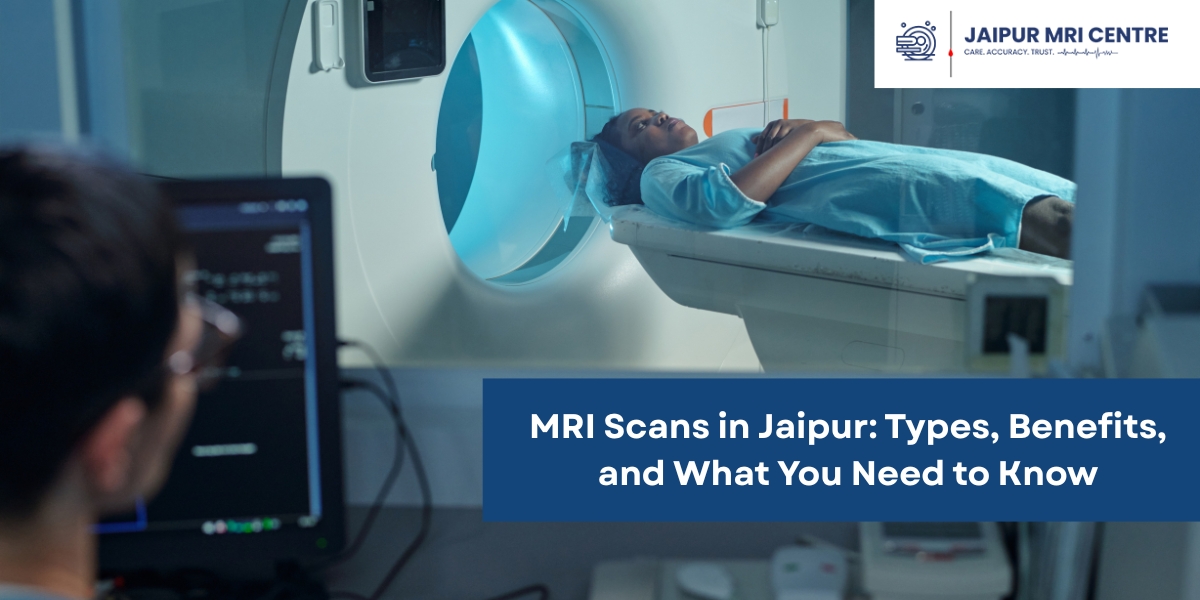
If you’ve been advised to undergo an MRI and are wondering why it’s necessary, this guide provides everything you need to know. From understanding the technology to finding the best diagnostic options in Jaipur, we’ve covered it all.
Magnetic resonance imaging (MRI) is one of the most popular diagnostic imaging methods of modern medicine. Unlike in CT or X-rays, ionizing radiation is not applied in MRIs.

Have questions about your scan? Speak with a Jaipur MRI Centre Expert
 Get a Callback
It produces detailed images of organs and tissues of the body by the use of radio waves, powerful magnets and a computer. Although magnetic resonance imaging (MRI) began its clinical adoption in the 1970s and 1980s, the technology has transformed how many disorders are diagnosed and monitored by physicians. Being such an advancement and important thing in medical centres, let’s know what is it and how it is important.
Magnetic Resonance Imaging is also known as MRI. The technology is based on nuclear magnetic resonance where the hydrogen atoms in the body respond to a strong magnetic field.
Since the human body is predominantly composed of water, and water consists of hydrogen atoms, MRI can produce exceptionally detailed scenic pictures of the soft tissues.
The modern MRI system owes its invention to the work of scientists like Raymond Damadian and Paul Lauterbur who assisted in transforming the theoretical aspect of physics into a practical medical imaging.
An MRI machine consists of:
In the scan, the patient is put in a cylindrical machine. Hydrogen atoms are aligned within the body due to the magnetic field. Radio waves are then introduced and this alignment is disturbed. When the radio waves are switched off, the hydrogen atoms go back to the initial position and give out the signals that are caught and translated into pictures.
MRI has proven to be the best method as it provides very high-resolution images of soft tissues. It is usually applied to study:
Physicians recommend undergoing an MRI done to identify tumors, strokes, rupture of the ligament, problems with the spinal discs, and lots of other medical issues. It is particularly desired in cases where soft tissue contrast is imperative.
MRI scans come in a number of varieties, and each type is aimed at a particular diagnostic aspect. The most common types of MRI in Jaipur are listed below:
The most common and popular type is this one. The images of organs and tissue created by structural MRI are detailed and assist the doctor to determine the presence of abnormalities in the organs including tumors, inflammation, bleeding, and structural destruction. It is widely applied in the neurology, orthopedics, and oncology.
Don’t have a prescription? Consult a doctor online
Functional MRI (fMRI) is used to measure the activity of the brain by measuring the changes in the blood flow. When some of the parts of the brain are engaged, it uses more oxygen and the fMRI can identify such changes in oxygen levels and visualize brain activity in real time.
This form of MRI is a common technique in neuroscience studies, and prior surgery planning on the brain surgery. It assists the doctors in determining the regions that cause speech, movements and memory.
Cardiac MRI is specifically used on the heart and blood vessels around the heart. It gives specific images of the structures of the heart, its functioning, and circulation of blood. Cardiac MRI is used in order to diagnose:
It is mostly favored since it provides accurate imaging without the use of radiations.
Magnetic Resonance Angiography (MRA) is a special MRI procedure that is applied to visualize blood vessels. It helps detect:
MRA is usually applied to scan arteries in the brain, neck and other body regions.
Magnetic Resonance Spectroscopy (MRS) is not similar to the conventional MRI as it does not merely generate images but examines the chemical composition of tissues. It assists in monitoring any changes in metabolism of tissues and more so in the brain.
MRS is able to help diagnose such conditions as brain tumors, epilepsy, and some metabolic disorders.
The open MRI machines have an open form as opposed to a closed cylindrical pipe. They are best used with patients who:
Though there are instances when open MRIs can offer a lower image resolution than closed systems, the current technology has advanced it to a great extent.
In other scenarios, a contrast agent (usually containing gadolinium) is introduced into the bloodstream of the patient prior to the scan. This improves the clarity of images and contributes to the creating of an abnormality like a tumor, infection, or issues with blood vessels.
Contrast MRI is mainly applied in the detection of cancer and inflammatory diseases.
Advantages of MRI
MRI has a number of important advantages:
Thanks to these benefits, MRI has become the product of choice when compared to CT scans in a variety of neurological and musculoskeletal conditions.
| Feature | Magnetic Resonance Imaging (MRI) | Computed Tomography (CT Scan) |
| Technology Used | Powerful Magnetic Fields & Radio Waves | Ionizing Radiation (X-rays) |
| Radiation Exposure | Zero Radiation. Completely safe for repeat scans. | Involves low-dose ionizing radiation. |
| Best For | Soft Tissues: Brain, spinal cord, ligaments, tendons, and nerves. | Hard Tissues: Bone fractures, chest/lung issues, and internal bleeding. |
| Scan Duration | Longer (typically 20 to 60 minutes). | Very fast (typically 5 to 10 minutes). |
| Level of Detail | Extremely high contrast for soft tissues and organs. | High detail for bone structures and vascular issues. |
| Patient Experience | Can be noisy; requires the patient to stay very still. | Quiet and quick; easier for trauma patients. |
| Cost in Jaipur | Generally higher due to advanced technology. | Generally more affordable than an MRI. |
Although MRI has a number of strengths, it has certain limitations:
MRI scan should not be performed on patients using pacemakers, metal fragments or other types of implants without the knowledge of their doctors.
The MRI technology is still in development. State-of-the-art equipment’s like 3 Tesla and even a 7 Tesla MRI scanner gives better resolution images. MRI analysis is also being incorporated with artificial intelligence that enhances the quality of diagnostic accuracy and shortens the scan time.
Researchers also develop faster imaging methods and portable MRI, which can help increase the availability of high-quality diagnostics in all parts of the world.
When you want to get an MRI scan in Jaipur, then a good diagnosis centre is the right choice where you could get the required results and enjoy the process. JAIPUR MRI CENTRE has a range of modern equipment and professional radiology personnel to provide advanced imaging services in MRI.
A convenient experience in the quick appointment booking, professional advice on the scan process and timely reports can be useful in assisting the patients to enable the doctors make the correct diagnosis.
Having been referred by your doctor to have an MRI of your brain, spine, knee, abdomen, and any other part of the body, they specializes in giving you accurate images and patient-centric care. Offering a convenient way of making an appointment ONLINE and a promise of high standards of diagnostics, it can be considered a reliable option in terms of people who have to get an MRI scan in Jaipur. BOOK APPOINTMENT NOW!
In conclusion, one of the most potent and diverse diagnostic methods in the contemporary medicine is Magnetic Resonance Imaging.
In identifying the brain tumors as well as the heart functioning and analyzing of the blood vessels, MRI has a very important role to play in the healthcare sector. It provides specialized imaging of diverse medical requirements with different types of fMRI, MRA, Cardiac MRI, and MRS.
With the increasing technology, MRI will still be used to improve early diagnosis, treatment planning, and finally save life. The knowledge of its types and uses can make patients understand why this great medical invention is worth appreciating.
The cost MRI scan in Jaipur typically range from ₹3,000 to ₹15,000, depending on the type, the use of contrast dye, and the diagnostic center you got appointment at.
CT scans create images of bones and soft tissues. However, they aren’t as effective as MRIs at exposing subtle differences between types of tissue.
MRI scans are generally very safe, non-invasive, and do not use ionizing radiation. They are safe for all the patients including children and the elderly.
A standard MRI scan does not scan the whole body; it typically focuses on a specific area like the brain, knee, or spine. However, a specialized “whole-body MRI” scan exists at JAIPUR MRI CENTRE, which uses advanced, non-invasive technology to create images of the head, neck, chest, abdomen, and pelvis in about 40–60 minutes.


Need Help