
High Technology:
Offering appointment booking for high-frequency echo options to suit specific clinical requirements.
Are you searching for reliable and affordable ECG test in Jaipur? This quick, painless, and non-invasive test records the electrical activity of your heart. Through the test, our doctors can detect heart rhythm problems, chest pain causes, previous heart attacks, and other cardiac conditions as soon as possible.
JAIPUR MRI CENTRE help you book your ECG test at trusted diagnostic centres in Jaipur with experienced team, modern equipment, and accurate reporting. Get quick appointments, affordable pricing, and timely reports — all hassle-free.
For precise heart health check, up and your own comfort, schedule your ECG test in Jaipur without delay. BOOK NOW!!
The electrocardiogram (EKG), also known as an ECG, serves as a straightforward tool for used by diagnostic centres in Jaipur assessing cardiac function quickly. Small, adhesive electrodes – typically made of flexible plastic material – are strategically positioned on specific areas such as the torso, upper limbs, and lower extremities for monitoring purposes.
Electrodes are linked to an electrocardiograph via leads. Heart rhythm data is subsequently recorded, analyzed, and displayed on paper. There’s no electrical current transmitted within the organism.
Electrical signals in nature control the beating of various sections within the heart so as to ensure smooth circulation of blood properly. The ECG captures these signals to illustrate the heart’s rate, its regularity or irregularity in beat patterns, and when each part of the heart receives an electric pulse sequence. Alterations on an electrocardiogram may indicate various cardiac issues.
This table uses usual adult resting ECG reference values for education use. Values can shift based on age, sex, symptoms, medicines, and the reporting doctor’s reading.
| ECG parameter | Usual normal range / finding | Unit / reference |
|---|---|---|
| Heart rate (resting sinus) | 60–100 | beats/min |
| Heart rhythm (sinus rhythm) | Regular; P wave before each QRS and each P followed by QRS | Pattern |
| P wave axis | 0° to +75° | Degrees |
| PR interval | 0.10–0.20 sec | 100–200 ms |
| QRS duration | 0.07–0.10 sec | 70–100 ms |
| QRS axis (frontal plane) | -30° to +90° | Degrees |
| QTc (men) | 350–450 ms | Milliseconds |
| QTc (women) | 360–460 ms | Milliseconds |
| ST segment | Usually near baseline (isoelectric), horizontal or slightly off baseline | Pattern |
| T wave | Usually in the same direction as QRS in many leads | Pattern |
| Q wave duration (general) | < 0.05 sec in most leads (V1–V3 any Q wave is usually abnormal) | < 50 ms |
We use computerized ECG systems for digital accuracy, providing instant reports that can be shared immediately with your cardiologist via WhatsApp or our team will contact you.

Your doctor might require an ECG due to various potential needs:
In order to assess potential issues related to the heart, symptoms like extreme fatigue, difficulty breathing, lightheadedness, or loss of consciousness should also be considered.
For evaluating cardiovascular well-being prior to surgeries like coronary artery bypass grafting; post-treatment recovery from myocardial infarctions involving damaged hearts; healing phases due to infective endocarditis affecting valve tissues; or outcomes following open-heart operations or angioplasties aimed at treating blocked arteries.
Determine the efficacy of specific cardiac medications in practice. For an initial assessment of the heart’s functionality through a medical examination, this trace serves as a reference point against subsequent electrocardiogram readings over time.
Your healthcare provider might suggest an electrocardiogram due to potential additional causes.
*** If you need ECG test appointment in Jaipur, then book with JAIPUR MRI CENTRE.
Offering appointment booking for high-frequency echo options to suit specific clinical requirements.
Only platform open round-the-clock for ECG appointments and emergency cases in Jaipur.
All scans are supervised and verified by senior radiologists ensuring standard diagnostic accuracy.
An ECG is a quick, easy way to assess the heart’s function. Risks associated with ECG are minimal and rare. You won’t feel anything during the ECG. You may feel some discomfort when the sticky electrodes are taken off. If the electrode patches are left on too long, they may cause skin irritation. There may be other risks depending on your specific medical condition. Be sure to discuss any concerns with our verified diagnostic centres in Jaipur before the test.
Certain factors or conditions may interfere with or affect the results of the ECG. These include:
An ECG test includes multiple waves, segments, and intervals shown on the tracing. Each one reflects a different part of the heart’s electrical activity. When read together, these findings help doctors assess heart rate, rhythm, conduction, and possible cardiac changes.
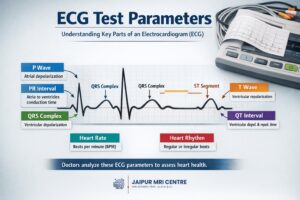
ECG wave and interval related parameters
Clear reporting of these parameters helps doctors interpret the ECG in the right clinical context and decide if more cardiac testing is needed.
You should be able to go back to your normal diet and activities, unless your provider tells you differently. Generally, there is no special care needed after an ECG.
Tell your provider if you have any chest pain, shortness of breath, dizziness, fainting, or other symptoms that you had before the ECG. Your provider may give you other instructions after the test, depending on your situation.
Book Today at Jaipur’s Trusted Diagnostic Platform.

This test records the heart’s electrical activity to diagnose the issues like heart attacks, arrhythmias, and coronary artery disease.
Electrocardiogram scans are generally safe, non-invasive and have no risks. There is no radiation exposure.
A normal 12-lead ECG scan typically costs between INR 150 and INR 500 in Jaipur. The average cost of ECGs is under ₹400.
Standard ECG scan results are often available immediately or within minutes, as the heart’s electrical activity is recorded in real-time. While the physical test only takes about 5-10 minutes.


Need Help