Yes, for most people a CT scan is safe when a doctor recommends it and it is done at a properly licensed centre. CT uses ionising radiation, so there is a small long-term risk that adds up with repeated scans. In most cases, the benefit of an accurate, timely diagnosis outweighs that risk. Pregnancy and childhood need extra care.
A Computed Tomography (CT) scan is a crucial component of a doctor’s diagnostic process when a patient is recommended to have it. A CT scan produces detailed cross-sectional images of bones, blood vessels and soft tissues, giving a clearer picture than can be seen on a standard X-ray. A CT scan can help identify complex structural abnormalities, as well as provide detailed views of bones, blood vessels and soft tissues when treating persistent internal pain or investigating an acute injury.
But it is perfectly normal to have a pinch of hesitation when you hear the word “radiation. Some of the most frequently asked questions people ask about radiation include, “How much radiation am I really getting?” “Are children or seniors safe for CT scanning?” and “How many times is it safe to have a scan?”
By understanding the safety of a CT scan, assessing the risks involved, and knowing some key precautions, you can make your healthcare journey a more confident experience.
Understanding the inner workings of a CT scanner is useful for assessing its safety.
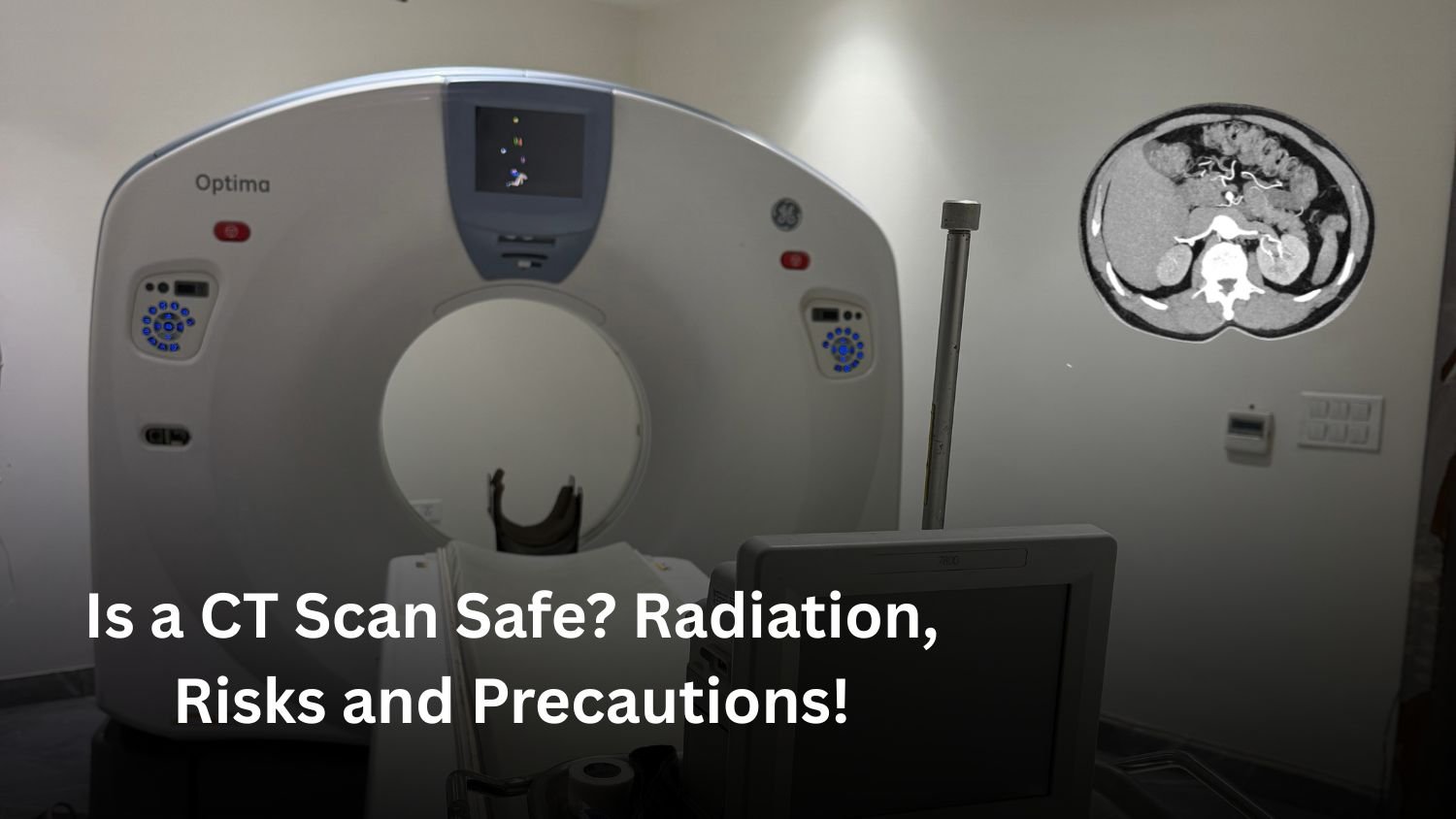
A CT scanner rotates a motorised X-ray tube around your body 360 degrees, unlike a typical X-ray, which only captures one 2D picture of the body. It rotates as it emits narrow, fan-shaped beams of X-rays through the area being scanned. The amount of radiation absorbed by different tissues (bones absorb more, soft tissue absorbs less) is measured by digital detectors and fed to a computer.
These “slices” are then fed into the computer, which creates detailed 2D and 3D images of the inside of your body.
Because a CT scan is built from many X-ray measurements, it delivers more ionising radiation than a single X-ray. Understanding how much is the key to judging its safety. If your doctor has advised a scan, you can read about the test and its preparation on our CT scan in Jaipur page.
Book your CT scan appointment online with a verified diagnostic centre. Quick slots, clear pricing and no long waits.
Prefer to talk? Call us or message us on WhatsApp.
The main safety issue with an MRI is the radiation emitted. Ionising radiation has enough energy to detach electrons from atoms, and can, at sufficient levels, break the DNA in cells.
Medical physicists use millisieverts (mSv) to measure radiation dosage.
All of us are living with naturally occurring background radiation all the time – from the soil under our feet, from trace elements in our food, from cosmic rays coming from space, and from building materials. The average background radiation that a human will receive naturally is approximately 2-3 mSv per year.
The following is a comparison of common diagnostic procedures to natural background radiation:
| Diagnostic Procedure | Typical Radiation Dose (mSv) | Approx. equivalent background radiation |
| Chest X-Ray (Single View) | ~0.1 mSv | ~10 days |
| Mammogram | ~0.4 mSv | ~7 weeks |
| CT Head / Brain | ~1 to 2 mSv | ~8 months |
| CT Chest | ~4 to 7 mSv | ~2 years |
| CT Abdomen & Pelvis | ~8 to 10 mSv | ~3 to 4 years |
| CT Angiography | ~5 to 12 mSv | ~2 to 5 years |
Doses are approximate and vary with the body part, patient size, scanner and protocol. Source for typical CT doses: U.S. FDA, “What are the Radiation Risks from CT?”
Radiation is the most widely publicised component of CT scanners, but it is not the only component to consider. When you know what all of the risks are, you will be fully equipped.
In many cases, a CT scan will require an injection of a special liquid dye into a vein (known as an IV contrast agent) to make the blood vessels, organs or active inflammation visible. Contrast dye is usually very safe, but may have some minor side effects:
If the patient has a pre-existing problem with kidney function or severe dehydration, the iodine-containing dye may cause temporary stress to the kidneys. Before ordering a contrast-enhanced CT scan, physicians routinely check certain blood tests, such as the patient’s Serum Creatinine and eGFR (Glomerular Filtration Rate).
The field of radiology has developed by leaps and bounds in the past decade. Today’s multi-slice CT scanners (64-slice, 128-slice and beyond) are equipped with advanced hardware and software that can improve patient safety.
Advanced software called Iterative Reconstruction Algorithms eliminates digital noise from the image, enabling the radiologist to obtain a crystal-clear image with up to 40% to 60% less radiation dose than the older systems.
The Automated Exposure Control (AEC): Modern machines self-control the radiation beam intensity in real time depending on the thickness and density of the part of the body being scanned.
Low-Dose CT (LDCT): LDCT is an imaging test that produces high-resolution images of the chest and is used specifically for lung cancer screening and high-risk health assessments, with the dose of radiation being a small fraction of that used for a traditional CT scan (~1.5 mSv).
Patients should take certain precautions before undergoing a CT scan. In order to make your scan as safe and as accurate as possible, here are some things you can do in advance:
Drink plenty of water before and after a contrast CT scan to rapidly clear the contrast.
Maintain a Record of Your Diagnostic History: Your healthcare team will want to see your history of exposure to X-rays, computed tomography (CT) scans and radiation; keep a record of these for them.
Need a CT scan in Jaipur? Book your appointment online with a verified diagnostic centre.
In most cases, the benefits of a CT scan outweigh the very small risk of getting it when ordered by a doctor for diagnosis. The health risks of an undiagnosed or delayed diagnosis of an internal injury, organ problem, or vascular congestion are much, much higher than the risks from the scan.
But the location of your scan is very important.
If your scan is performed on the latest, well-calibrated, multi-slice equipment at a certified diagnostic centre, you can be certain that the dose of radiation you receive will be as low as possible and your diagnosis will be as accurate as possible.
Don’t let the process of deciding on a diagnosis, understanding machine specifications, or finding accredited laboratories become a burden in your health care process. JAIPUR MRI CENTRE is an online diagnostic appointment booking platform that connects patients with the best diagnostic centres in Jaipur.
The diagnostic experience at Jaipur MRI Centre is safe, smooth and economical; here’s how:
A CT scan is one of the most powerful, non-invasive diagnostic tools in modern medicine. When performed on modern equipment with appropriate protocols, its safety profile is exceptionally high, and the medical benefits of an accurate, timely diagnosis far outweigh the minor radiation risks.
If your doctor has recommended a CT scan, book your CT scan in Jaipur today.
It depends on the body part: roughly 1 to 2 mSv for a head CT, 4 to 7 mSv for a chest CT and 8 to 10 mSv for an abdomen and pelvis CT. Natural background radiation averages about 2 to 3 mSv per year.
CT of the abdomen or pelvis is generally avoided in pregnancy. Doctors usually choose ultrasound or MRI unless it is a life-threatening emergency. Always tell your doctor and the scan team if you are or may be pregnant.
Children are more sensitive to radiation, so CT is used only when clearly needed, with doses adjusted to the child’s size and weight.
This article is for general information only and is not a substitute for medical advice. Always follow the advice of your doctor and radiologist.


Need Help