If you or someone near you is showing signs of a stroke right now — sudden face drooping, arm weakness, or slurred speech — call emergency services immediately. Do not wait to book a scan. The information below is for understanding stroke imaging, not for use during an active emergency.
A stroke is a medical emergency that happens when blood flow to part of the brain is interrupted, or when a blood vessel in the brain ruptures. Because brain cells can begin to suffer damage within minutes, getting a stroke diagnosed quickly and treated is extremely important.
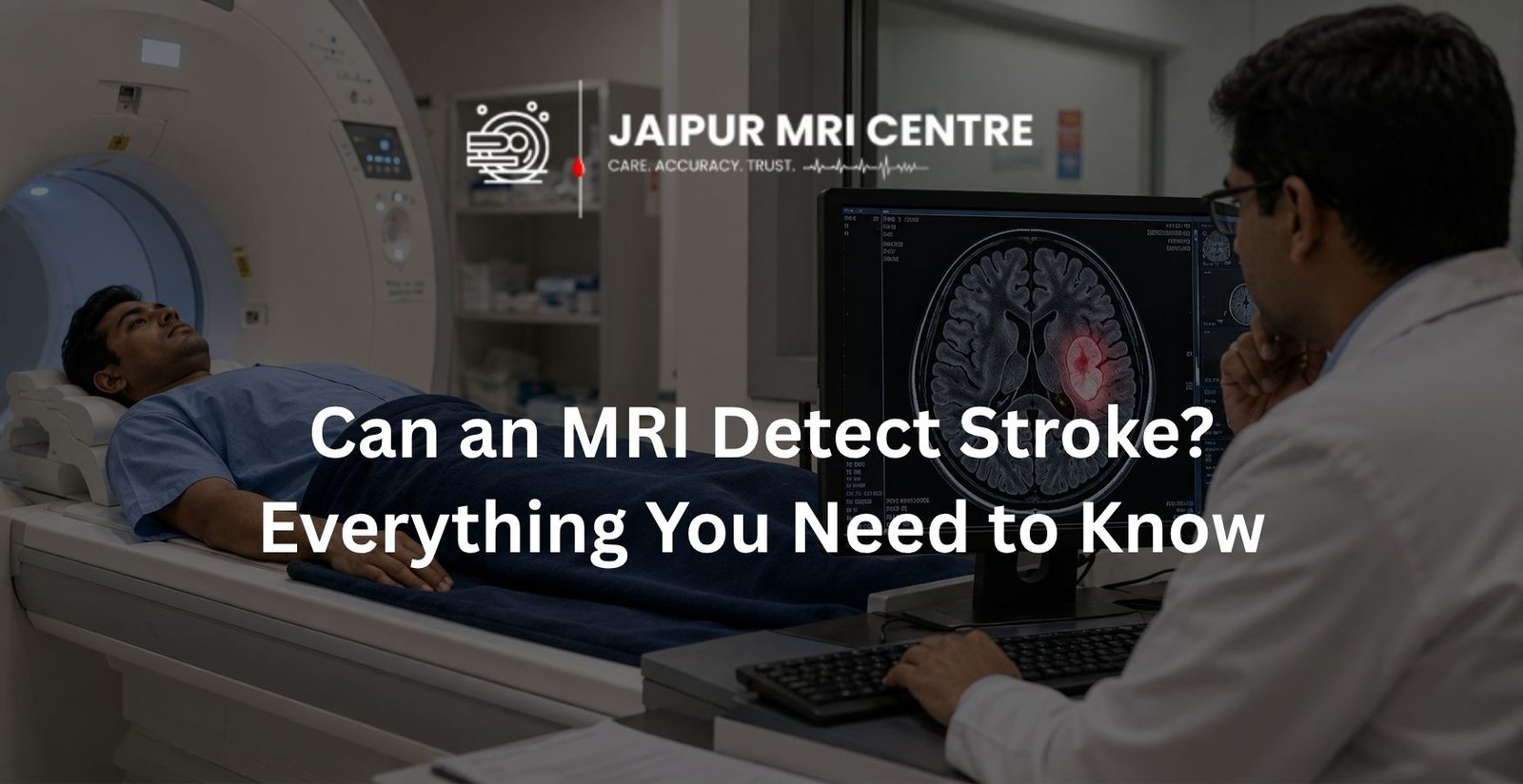
If you’re researching whether an MRI can detect a stroke, the short answer is yes — MRI can detect most strokes, particularly ischemic strokes, and can sometimes identify very small or early areas of brain damage that a CT scan might miss.
However, MRI is not always the first test performed when someone has suspected stroke symptoms. This guide walks through what MRI can and can’t tell you about a stroke, and how Jaipur MRI Centre can help you get a scan booked quickly once you’re in a position to do so.
A stroke is an interruption in blood supply to the brain. It occurs when the brain does not receive enough blood and oxygen or when bleeding occurs inside the brain. There are two main types of stroke: Ischemic stroke and Hemorrhagic stroke.
This is the most common type of stroke that is seen in patients. It happens when a blood clot or other blockage prevents blood from reaching part of the brain. Without adequate oxygen, brain tissue can become damaged.
A hemorrhagic stroke occurs when a blood vessel in the brain ruptures and causes bleeding. The blood can put pressure on surrounding brain tissue and cause damage.
Because these two types of stroke require different treatments, doctors need to determine what type of stroke has occurred as quickly as possible. Once you’re through the acute emergency phase and a doctor recommends imaging, you can book an MRI appointment at a verified diagnostic centre in Jaipur.
Yes. A brain MRI scan can be ordered by doctors in Jaipur to help identify an acute ischemic stroke. Brain MRI is considered highly sensitive, particularly when special sequences like diffusion-weighted imaging (DWI) are used.
MRI can detect regions of the brain deprived of blood flow, and in many cases these changes are visible quite early after a stroke occurs.
MRI can also help doctors:
An MRI cannot always replace other tests, though. Doctors may also use CT scans, CT angiography, blood tests, heart tests, and other investigations depending on the patient’s condition.
MRI uses a powerful magnet and radio waves to create detailed images of the brain. Different MRI sequences reveal different kinds of information.
DWI is especially useful for diagnosing acute ischemic stroke. It detects changes in the movement of water within damaged brain cells, which can reveal a stroke very early on.
FLAIR is another MRI sequence which is useful for doctors to look at brain tissue abnormalities. It can help to establish if a brain injury may be recent, and to identify other conditions that can mimic stroke.
MR angiography (MRA) may be used to look at blood vessels in the brain and neck. May assist in detecting narrowed or blocked arteries or other abnormalities of the blood vessels.
Together, these techniques give doctors a comprehensive picture of both the brain tissue and its blood flow.
It depends on the situation. MRI is generally more sensitive than a standard non-contrast CT scan for detecting early ischemic stroke, particularly small strokes. However, CT has an important advantage: it is extremely fast and widely available.
When a person shows sudden signs and symptoms of stroke, doctors need to rapidly assess whether there’s bleeding in the brain, and whether the patient might be a candidate for urgent treatment. A CT scan can quickly detect brain hemorrhage and help guide that decision.
MRI is more time-consuming and may not be possible for some patients, including those who are unstable, cannot stay still, or have some medical devices or other contraindications.
So it’s not about which scan is more detailed — it’s about which one can give doctors the information they need quickly and safely.
Yes, particularly with small or early ischemic strokes. A standard CT scan can sometimes appear normal even when a patient is having a significant stroke. Diffusion-weighted MRI (DWI) is often able to identify these changes at an earlier stage.
For this reason, an MRI may be ordered after a CT scan if a doctor is still unsure what’s causing a patient’s symptoms. This doesn’t mean CT is ineffective — in emergency stroke workups, CT remains very important for assessing bleeding and guiding urgent treatment decisions.
A TIA (transient ischemic attack) is sometimes referred to as a “mini-stroke”. It is a temporary interruption of blood supply to part of the brain and the symptoms go away. A TIA may not result in permanent brain damage, unlike a completed ischemic stroke. Thus, MRI might be normal post TIA.
In some cases, however, an MRI may reveal small areas of brain damage if they have had signs and symptoms that appeared to be a TIA.
A normal results from an MRI should not rule out sudden onset symptoms of weakness, drooping face, difficulty speaking or vision problems. The TIA may be a warning sign of a stroke.
MRI with diffusion-weighted imaging can detect many acute ischemic strokes within minutes to hours after symptoms begin. The exact visibility depends on several factors, including:
Very small strokes or strokes in certain areas of the brain can occasionally be difficult to detect, so doctors interpret MRI results together with the patient’s symptoms and examination.
MRI can offer clues about how old a stroke is. For example, diffusion imaging can sometimes help physicians estimate how much time has passed since the stroke occurred, while FLAIR imaging can offer clues as to whether the injury looks recent or long-standing.
That said, MRI isn’t always precise about the exact time of onset. Doctors evaluate the scan alongside the patient’s symptoms, medical history, and the last time they were known to be well.
There are many types of stroke that MRI can detect, but none is perfect. Diffusion-weighted MRI offers the best evaluation of ischemic strokes. MRI also can demonstrate changes in the brain from a hemorrhagic stroke, but it may not be the first test used if the physician wants to make a quick determination that there is no bleeding.
MRI can also help rule out complications or other problems which could mimic stroke symptoms.
More than one test is typically required to evaluate a stroke. Doctors may use any of the following:
The exact combination of tests will vary based on the patient’s symptoms and medical history.
It is important to be aware of the warning signs rather than what scan to choose. Remember FAST:
F – Face: One side of the face may droop.
A – Arms: One arm may be weak or numb.
S – Speech: Speech might be slurred, confused, or hard to understand.
T – Time: Call emergency medical help immediately.
Other signs and symptoms may be sudden:
If you notice any of these signs — in yourself or someone else — call emergency services right away. Certain stroke treatments only work if given within a specific time window, so every minute matters. Once a patient is stabilized and a doctor recommends follow-up or diagnostic imaging, you can check symptoms that may call for an MRI or book a scan directly.
MRI is safe for most people and doesn’t use ionizing radiation. However, because MRI relies on a powerful magnetic field, patients must tell the medical team beforehand if they have any metal-containing devices, such as a pacemaker, metal fragments, surgical clips, or other implants. You can read more about what to expect during an MRI scan if it’s your first time.
When a contrast is recommended, the doctor will also take into account kidney function and prior reactions to a contrast agent.
Yes — an MRI can detect a stroke, and it’s particularly sensitive for acute ischemic strokes. It can also give doctors a detailed picture of the location and severity of brain damage, and can catch tiny strokes that an early CT scan might miss.
MRI is not always the first scan conducted in the event of a stroke suspicion, though. CT is used first as it is quick and may help detect any bleeding in the brain.
The key takeaway: don’t wait for a specific scan during an emergency. Anyone with sudden face drooping, weakness, trouble speaking, vision changes, severe dizziness, or other stroke symptoms should seek emergency medical attention immediately.
MRI is a very sensitive diagnostic test for many strokes; however, the choice of MRI versus a CT scan will depend on the patient’s symptoms, time, condition and what the doctor needs urgently.
Yes. MRI, especially with diffusion-weighted imaging, is highly sensitive for detecting acute ischemic stroke and can pick up changes that a CT scan may miss.
CT is usually done first because it’s fast and effective at ruling out brain bleeding. MRI is more sensitive for detecting small or early ischemic strokes but takes longer to perform.
Sometimes. A TIA may not cause lasting damage, so an MRI can appear normal — but in some cases it reveals small areas of brain injury.
Yes, MRI is generally safe and doesn’t use radiation. Always inform the medical team of any implants, pacemakers, or metal devices before the scan.
Disclaimer: This blog is for informational purposes and should not replace professional medical advice. Please consult your doctor regarding any medical concerns or sedative options.
Skip the wait. Book your MRI appointment online in minutes.

Need Help