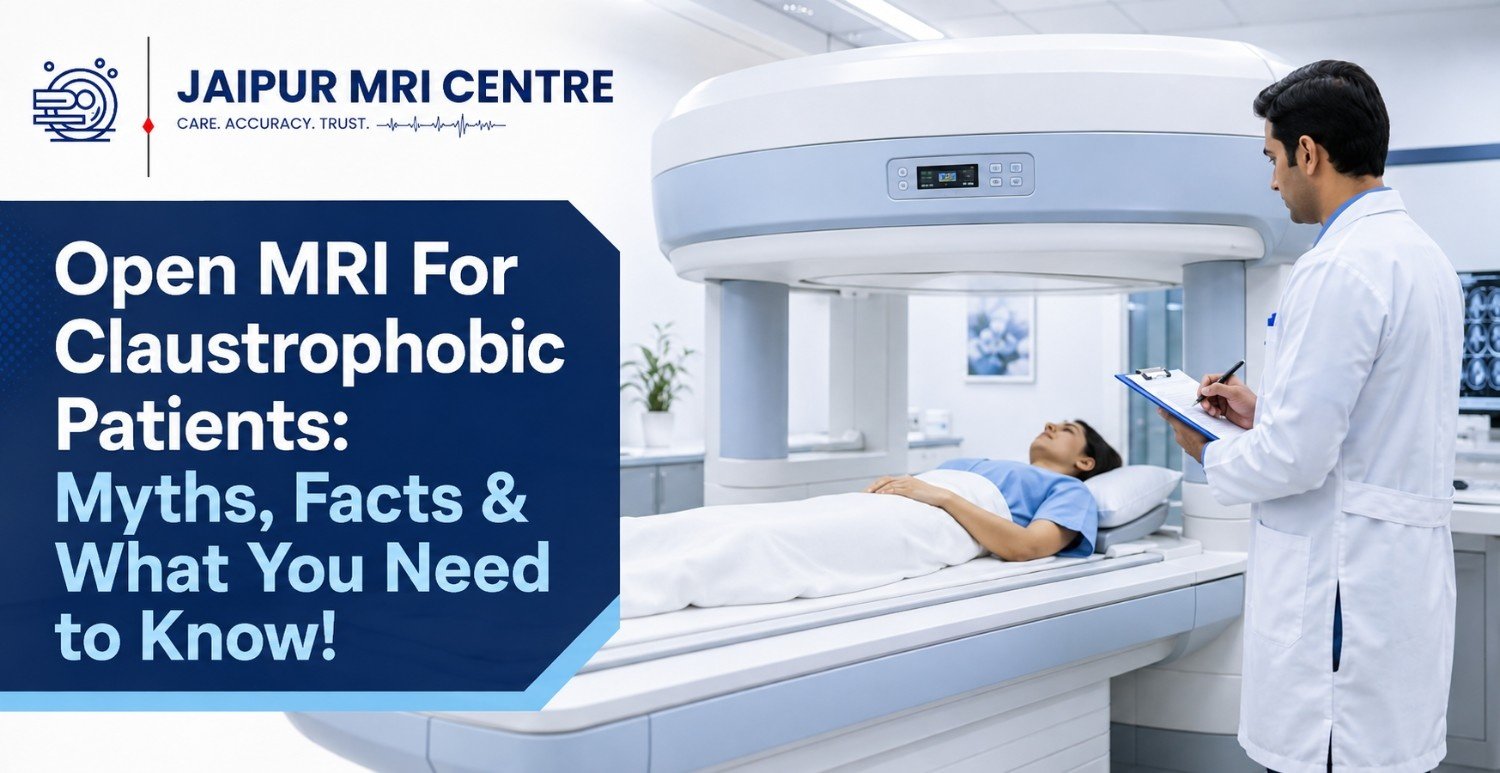
Have you delayed your MRI because you’re worried that you have to lie inside the machine? You’re not alone. Anxiety or claustrophobia is common when considering an MRI scan. Indeed, one of the most frequent reasons for a patient to postpone or cancel an important diagnostic test is fear of enclosed spaces.
Fortunately, there is a newer imaging technology that is more patient-friendly for those who are uncomfortable in the traditional MRI scanner – Open MRI.
In this guide, we explain what an Open MRI is, who may benefit from it, how it compares with a traditional MRI, common myths, advantages, limitations, and important safety considerations.
Traditional MRI scanners can feel uncomfortable for patients who experience claustrophobia because of their enclosed design. Open MRI systems are designed to provide a more spacious scanning environment and may be a suitable alternative for certain examinations.
An open MRI is a type of MRI machine that is designed to be more open than a traditional closed-bore MRI machine.
Open MRI systems can be designed with open sides or a broader configuration, allowing patients to ease their sense of confinement during the MRI exam, in contrast to the narrow tunnel many standard MRI scanners use.
Although strong magnetic fields and radio waves are used in the technology to create detailed images of the body’s internal structures, it does not rely on ionising radiation. Open MRI can help ease the anxiety and discomfort of the MRI scan for patients who experience claustrophobia, anxiety, obesity, or lack mobility.
Open MRI might be recommended for:
However, the most suitable MRI system depends on the type of examination, the area being scanned, and the image quality required by your doctor or radiologist.
| Feature | Open MRI | Traditional MRI |
| Design | Open on the sides or wider | Narrow tunnel |
| Best for | Claustrophobic and anxious patients | Most routine and specialised imaging |
| Patient Comfort | Higher | Moderate |
| Noise | Similar | Similar |
| Image Quality | Good for many examinations | Often provides higher detail, especially on high-field systems |
| Scan Time | May be slightly longer in some cases | Usually shorter on modern high-field scanners |
If enclosed MRI environments trigger panic, shortness of breath or a strong urge to leave the scanner, you may be experiencing MRI-related claustrophobia. Read our guide on managing MRI anxiety and panic during scans for preparation techniques.
Fact: One of the biggest misconceptions.
Open MRI yields superb diagnostic images for many medical conditions. Some studies of the brain or spine might require a higher field strength for the MRI, such as a 1.5 Tesla or 3 Tesla scanner. It doesn’t matter whether the machine is open or closed, it’s simply a matter of what part of your body is being examined and what your doctor recommends.
Fact: No.
Open MRI is not an X-ray or ionizing radiation procedure as is thought by some patients, but rather one that relies on the use of magnetic fields and radio waves.
Fact:
With the proper support, most claustrophobic patients can safely undergo an MRI scan. This can be performed with an Open MRI, a wide-bore MRI, relaxation or mild sedation (if appropriate and recommended by the treating doctor).
Fact:
MRI (open or closed) will not hurt at all. All you do is lie down and the machine takes pictures of you! Some people may feel discomfort from being in a particular position for the length of the scan.
Fact: Open MRI is suitable for adults as well.
It is frequently used for individuals who have anxiety, obesity, limited mobility and anyone who feels uncomfortable in the usual MRI scanner.
Yes. Open MRI is as safe as other MRI machines since it does not utilize ionizing radiation. Patients with a pacemaker, some metal implants, aneurysm clips or any other medical device that is placed into the body should inform the radiology staff prior to the scan, as some may not be MRI-compatible.
Having had a fear of MRI scans is quite normal but should not be a barrier to obtaining a diagnosis. For many, especially those with claustrophobia, anxiety or mobility issues, open MRI in Jaipur has made medical imaging more comfortable.
If you’ve been told by your doctor to have an MRI and you’re afraid of the closed MRI machine, be sure to talk to your doctor about your concerns prior to booking the appointment. The radiologist is able to suggest a type of scanner that will work best for your medical condition and image needs.
At JAIPUR MRI CENTRE, we assist our patients with booking appointments with trusted diagnostic centres in Jaipur, where these open MRI scans are available. We want the MRI experience for our patients to be as comfortable, safe and stress-free as possible.
Yes. With preparation, reassurance or an Open MRI or wide-bore MRI as appropriate, many people with claustrophobia are able to successfully undergo an MRI scan.
Not always. Although Open MRI can be used for most common exams, certain neurological, vascular or musculoskeletal studies may need high-field MRI systems to provide more detail. Your doctor will suggest the best type of scanner for your illness.
Some Open MRI scans may be longer than those taken with high-field MRI equipment, depending on the type of exam and the equipment used. This varies depending on the body area being assessed.
Yes. For kids who are claustrophobic, open MRI may be a better choice. In certain cases, sedation may still be needed to ensure that the young children are totally still during the scan.
Disclaimer: This blog is for informational purposes and should not replace professional medical advice. Please consult your doctor regarding any medical concerns or sedative options.
Reviewed By:

Dr. Hitesh Kumar, MD (General Medicine), Consultant Physician
This content has been medically reviewed for clinical accuracy and is updated in accordance with current nuclear medicine practices.
Last Reviewed: 09 August 2026
If enclosed MRI scanners make you anxious, talk to our team about available MRI options in Jaipur. Get guidance on choosing a suitable centre and scheduling your scan.


Need Help