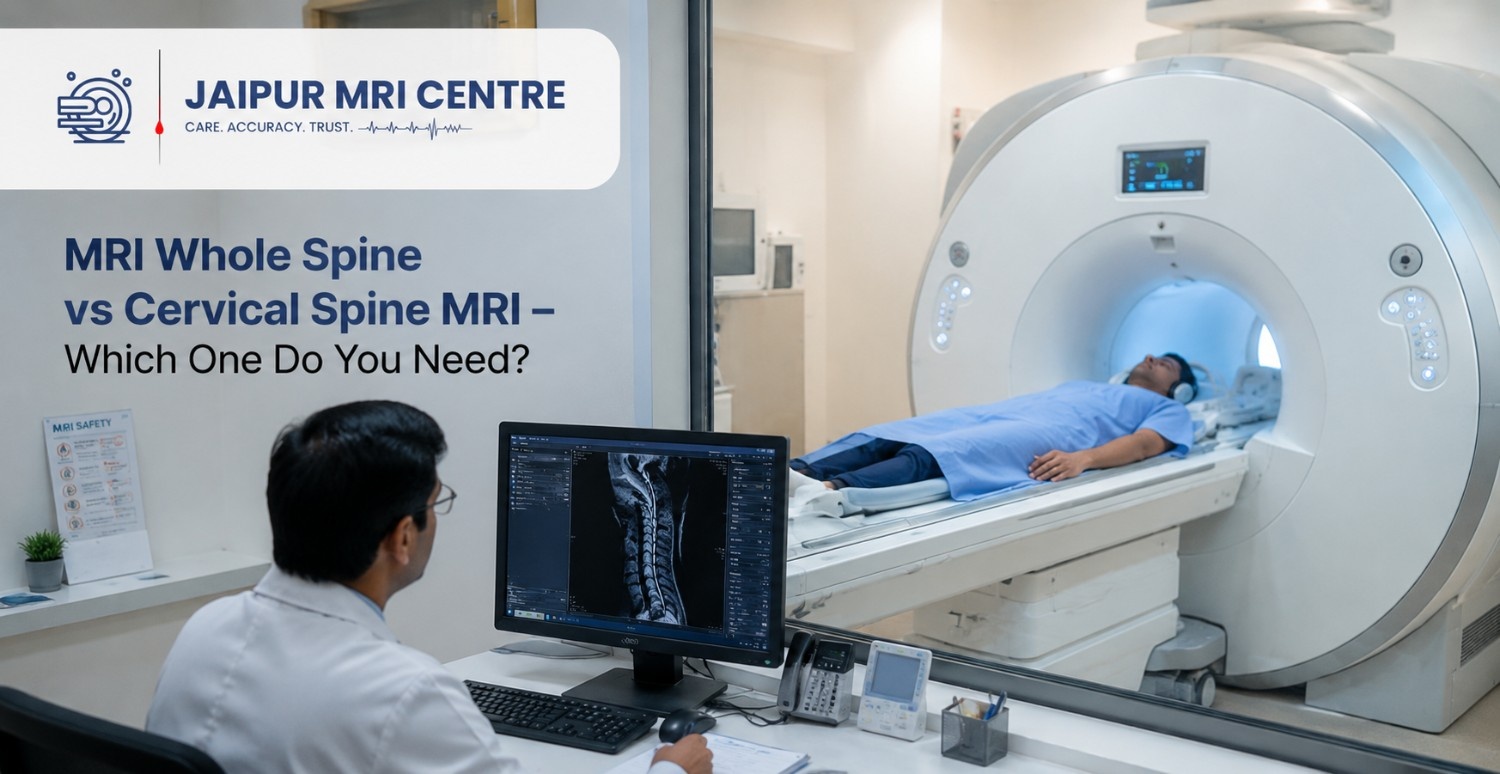
Written by: JAIPUR MRI CENTRE Editorial Team | Medically Reviewed by: Our Panel of Consultant Radiologists | Last Updated: July 5, 2026
Have chronic neck or back pain, numbness or tingling in arms or legs? Your doctor can order an MRI scan to determine the cause. But there’s always a question that comes to mind: Should I have an MRI Whole Spine or only a Cervical Spine MRI?
This will depend on your symptoms, medical history and the region your doctor thinks is affected. JAIPUR MRI CENTRE provide quick appointments our patients with advanced MRI services with high-quality imaging, experienced radiologists, affordable pricing and quick reporting to help them get an accurate diagnosis.

Get MRI Scan Price & Discount | Expert Help
 Call Now
During an MRI scan, your spine, spinal cord, discs, nerves, muscles and surrounding soft tissues are scanned in detail using strong magnets and radio waves. MRI imaging does not use ionising radiation, and will give you a very good view of soft tissues, which is much better than an X-ray or CT scan.
Patients are typically advised to have a spine MRI when they have:
Cervical Spine MRI scans only the neck area, made up of the 7 bones in the neck (C1-C7).
It is usually prescribed when the symptoms are felt in the neck and spread to the shoulders and arms.
A Cervical Spine MRI Can Detect:

Avail up to 25% Off On MRI Scan
Your doctor might order this test if you have:
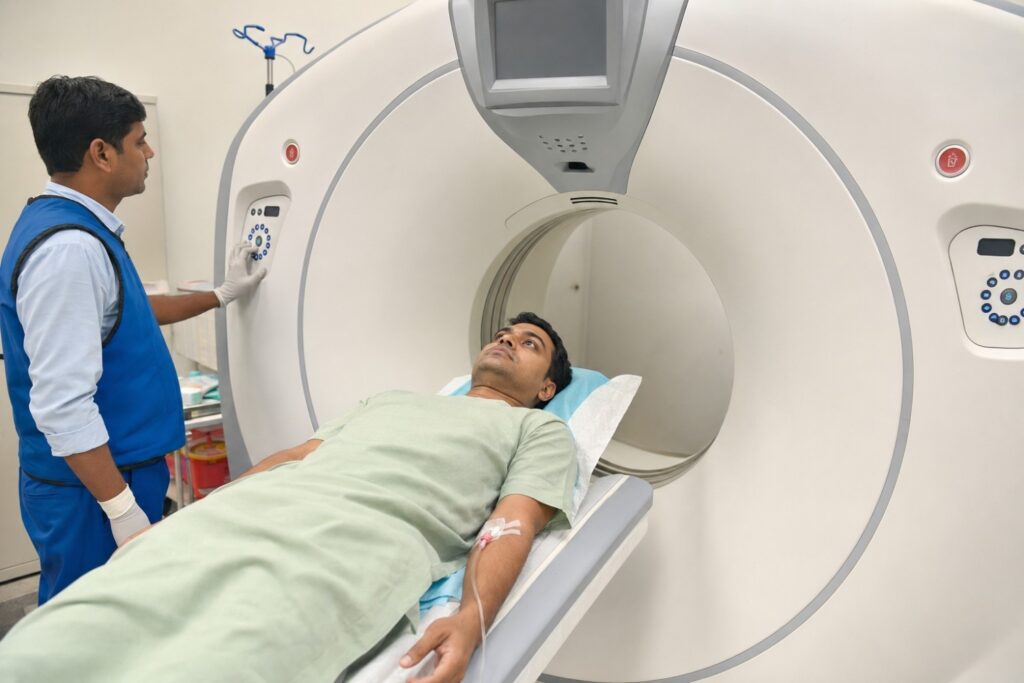
A Whole Spine MRI can be used to look at all three areas of the spine:
Your doctor may also recommend some scans of the sacral area. This scan rather than imaging one area, assesses the entire spinal column.
A Whole Spine MRI might be recommended if you have:
It is also recommended by doctors when they want to detect abnormalities which could be a problem with more than one part of the spine.
Avail Best Offers on MRI Scan >>
| Feature | Cervical Spine MRI | Whole Spine MRI |
| Area Covered | Neck only | Entire spine |
| Scan Duration | Around 20–30 minutes | Around 45–60 minutes |
| Best For | Neck pain and arm symptoms | Symptoms involving multiple spinal regions |
| Cost | Lower | Higher |
| Images | Cervical region | Cervical, Thoracic & Lumbar spine |
| Doctor Recommendation | Localized symptoms | Widespread or complex symptoms |
This will depend on the location of your symptoms, and will determine the right MRI.
Consider a Cervical Spine MRI when:
Your doctor suspects that your neck has a pinched nerve.
If you choose… Whole Spine MRI:
Yes. An MRI scan of the neck is only able to scan the cervical spine. Symptoms may not be noticeable if they are coming from the lumbar or thoracic spine.
For example:
The Whole Spine MRI will typically take longer as it’s a multi-segment imaging procedure.
The total duration of the cervical MRI is around 20–30 minutes.
Whole Spine MRI: ~45-60 minutes
The length of time will depend on the imaging protocol and whether or not contrast is needed.
The majority of MRI’s of the spine are done without contrast. But your doctor might suggest using contrast if they think you have:
The use of contrast will depend on your medical history and clinical indications and will be determined by your radiologist.
It is easy to prepare for an MRI of the spine:
If a contrast MRI is to be done, follow any special instructions provided.
For spine imaging, it is important to select a reputable diagnostic centre to guarantee the accuracy of the results. We at Jaipur MRI Centre offer you an appointment for the advanced MRI.
If your doctor recommends an MRI of the Cervical Spine, Lumbar Spine MRI, or Whole Spine MRI, the centres we are connected to provides accurate imaging results to aid in your medical decision-making.
Choosing between a Whole Spine MRI and a Cervical Spine MRI depends on your symptoms and your doctor’s clinical assessment. While a Cervical Spine MRI is ideal for evaluating neck-related conditions, a Whole Spine MRI provides a comprehensive view when symptoms extend across multiple regions of the spine.
If you’re looking for a reliable MRI centre in Jaipur, JAIPUR MRI CENTRE have diagnostic centres that offer advanced imaging technology, experienced radiologists, affordable pricing, and prompt reporting to help you get an accurate diagnosis and begin the right treatment without unnecessary delays.
Need to book an MRI Spine scan in Jaipur? Contact JAIPUR MRI CENTRE today to schedule your appointment and receive expert diagnostic care.
Not necessarily. The best scan depends on your symptoms. If your problem is confined to the neck, a Cervical Spine MRI is usually sufficient. A Whole Spine MRI is recommended when symptoms involve multiple spinal regions or require a more comprehensive evaluation.
Yes. It is one of the most effective imaging tests for diagnosing cervical disc bulges and herniated discs.
Yes. A Whole Spine MRI includes the cervical, thoracic, and lumbar spine.
A Cervical Spine MRI is generally the preferred scan for persistent neck pain, arm numbness, or suspected cervical nerve compression.
Yes. MRI is a safe, non-invasive imaging technique that does not use ionising radiation, making it suitable for evaluating most spinal conditions.
This article is for educational purposes only and should not replace professional medical advice, diagnosis, or treatment. Always consult your doctor or radiologist for medical concerns.
From brain and spine to joint and full body imaging, access safe and precise MRI diagnostics with quick appointment availability.


Need Help