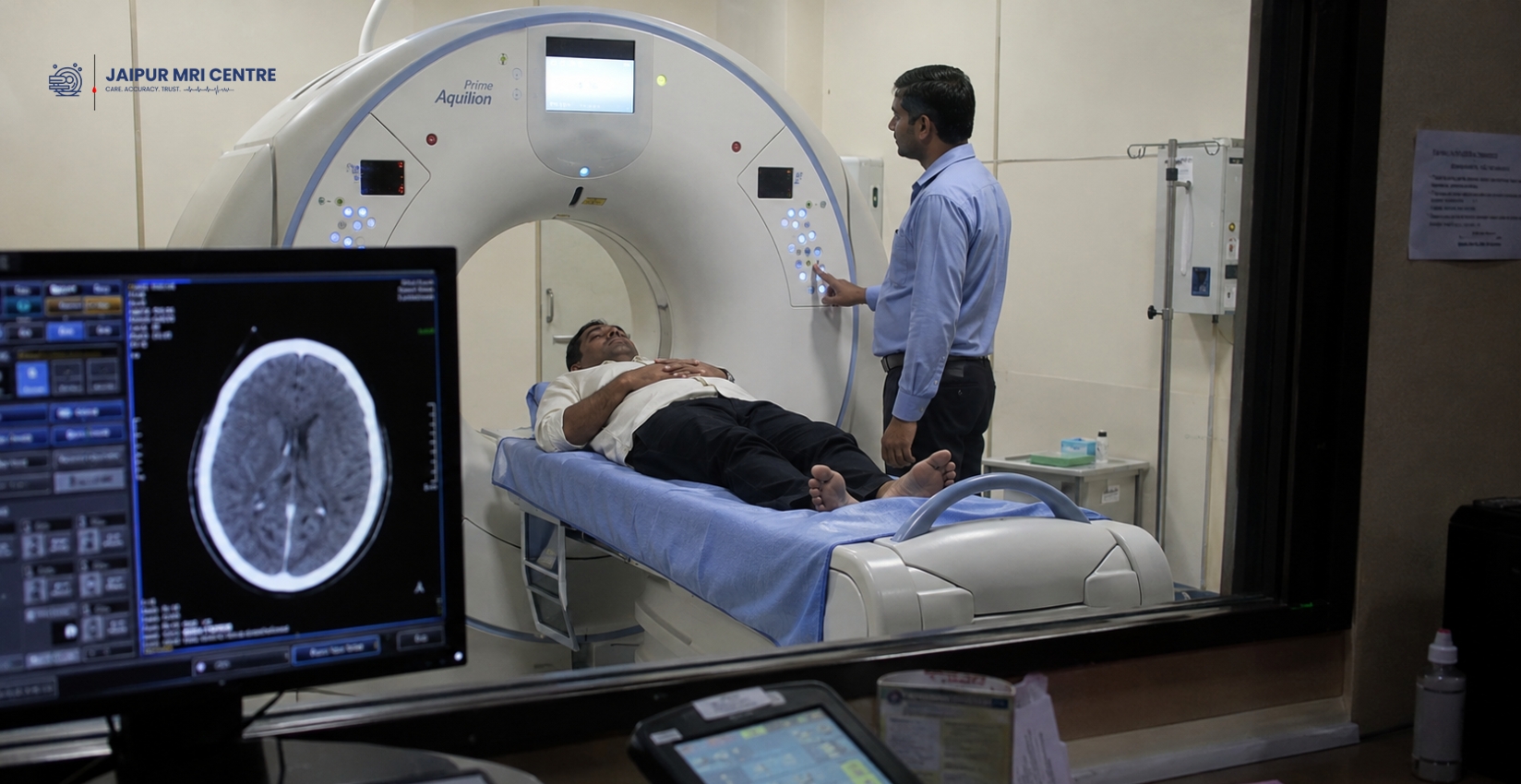
If someone experiences a sudden headache, head injury, severe stomach pain or unexplained dizziness, the cause should never be disregarded. In such an instance, an NCCT Scan is a recommended imaging test as it is one of the speediest and most efficient tests done to detect internal issues within the body.
At JAIPUR MRI CENTRE, patients can connect with trusted diagnostic centres in Jaipur equipped with advanced CT scan technology and experienced radiologists for accurate reporting.

Get CT Scan Price & Discount | Expert Help
 Call Now
Know what NCCT scans are, why they are done, how they are performed, what to expect before, during, and after the procedure, the advantages, risks, and cost of the scan in Jaipur.
In India, the NCCT scan price generally ranges between ₹2,200 and ₹6,000, depending on the body part being examined, the city, the hospital or diagnostic centre, and the type of CT scanner used.
Reviewed by Certified Radiology Experts:
Reviewed by certified radiology experts associated with JAIPUR MRI CENTRE.
The cost of an NCCT scan in Jaipur depends on the body part scanned, the technology used, the diagnostic centre, whether contrast is required, and whether it’s done in an emergency or routine appointment. Average NCCT scan prices in Jaipur:
| NCCT Scan Type | Market Price (₹) | Our Discounted Price |
| NCCT Head / Brain Cost in Jaipur | ₹1,200 – ₹2,500 | ₹2,200 |
| NCCT Chest Cost in Jaipur | ₹2,000 – ₹4,000 | ₹3,500 |
| NCCT Abdomen Cost in Jaipur | ₹2,500 – ₹5,500 | ₹6,000 |
| NCCT Spine Cost in Jaipur | ₹2,000 – ₹4,500 | ₹3,500 |
| NCCT KUB Cost in Jaipur | ₹1,800 – ₹4,000 | ₹5,000 |
| NCCT Joints Cost in Jaipur | ₹2,000 – ₹5,000 | ₹5,000 |
| NCCT PNS Cost in Jaipur | ₹1,500 – ₹3,000 | ₹4,000 |
At JAIPUR MRI CENTRE, patients can book affordable NCCT scan appointments at trusted diagnostic centres across Jaipur with transparent pricing and quick support.
Non-Contrast Computed Tomography (NCCT) is an imaging technique which takes detailed pictures of the body using X-rays and computer technology without the use of contrast dye.
An NCCT scan will provide detailed layers of bones, organs, blood vessels and tissues, unlike the flat image obtained by a regular X-ray. This way, physicians can get a more accurate diagnosis of injuries, bleeding, infection, swelling, fractures, tumors, and some other diseases.
The advantage of NCCT scans is that they are quick, painless, and are very effective in detecting serious conditions early, so they are often performed during emergency situations.
NCCT doesn’t use contrast dye. It is fast and is used in emergencies; it is very suitable for the detection of bleeding, fractures, stones, and trauma. In contrast-enhanced CT Scan (CECT) a contrast dye is used to increase the visibility of blood vessels, organs, tumours and soft tissues. A doctor will determine if contrast is needed depending on the condition being checked. Doctors decide whether NCCT or CECT is more suitable depending on the condition being evaluated.
| Feature | NCCT Scan | CECT Scan |
|---|---|---|
| Contrast Dye | Not used | Used |
| Preparation | Usually none | Fasting required |
| Kidney Risk | Minimal | Contrast may affect kidneys |
| Allergy Risk | Very low | Possible contrast allergy |
| Common Uses | Brain bleed, stones, fractures | Tumours, blood vessels, infections |
| Scan Time | Faster | Slightly longer |
The Contrast dye material that helps improve visualization of blood vessels, tumours, and certain organs. However, many conditions can be accurately diagnosed without contrast.
NCCT is recommended by doctors when they wish to obtain detailed, cross-sectional images of the body without using a contrast dye. The scan is quick and very detailed; therefore, it is frequently a first imaging test recommended during emergencies.
An NCCT scan might be requested if you have symptoms of:
In many cases, early diagnostic imaging using NCCT helps doctors begin treatment quickly and reduce the risk of complications, especially during emergency situations. Need urgent imaging? Book your NCCT scan appointment in Jaipur today.
Depending on the symptoms, NCCT scans may be taken of various parts of the body.
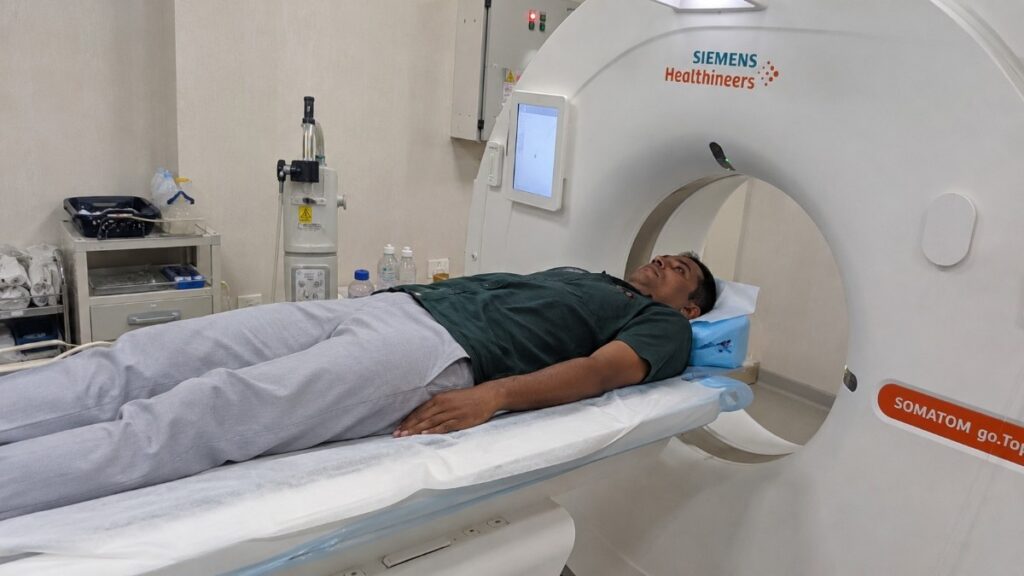
Image showing while the ongoing process of CT Scan Process by patient.
The NCCT Head scan is one of the most frequently ordered CT scans that are being done in the emergency room. A brain CT scan Jaipur is commonly advised in emergency neurological conditions. It helps detect:
Common Symptoms Requiring NCCT Brain
An NCCT Abdomen Scan can be used to assess the following organs in your abdomen:
It might be suggested if you have serious abdominal pain, kidney stones, infections, an enlarged abdomen, or an intestinal problem.
An NCCT chest scan provides detailed imaging of the lungs and surrounding chest structures when more detailed evaluation is needed beyond regular X-rays.
Usually recommended if X-rays show abnormalities or when symptoms are continuing.
The following is a list of the problems that are evaluated using NCCT Spine imaging:
KUB stands for the Kidney(s), Ureters and Bladder. It is widely used as a kidney stone CT scan because of its high accuracy. This scan is excellent in identifying:
This scan is used to assess the sinus area and can aid in the diagnosis of:
The knee, hip, shoulder, ankle, wrist and elbow are all areas that are common for this scan. CT imaging provides detailed views of bones and joints, helping doctors identify:
It is easy, painless and typically takes a few minutes. Upon arrival at the diagnostic centre you might be required to wear a hospital gown and remove glasses, metallic objects like jewellery, watches, belts, etc.
Then, you will be placed on a motorised table that will gradually move into the CT scanner. The scanner is a round piece that is open on both sides. The X-ray beams rotate around the body, while the computer creates detailed images of the inside of the body all the way round. In most cases, patients must remain still for imaging.
The overall CT scan procedure usually takes around 5–20 minutes depending on the body part being examined.
After scanning, patients may be able to return to normal activities right away. We help patients book NCCT scans in Jaipur at centres located in Vaishali Nagar, Malviya Nagar, Jagatpura, Mansarovar, Tonk Road, and nearby areas. Call now for same-day appointment availability!
In general, NCCT scans are considered safe when performed under medical supervision. CT scans involve controlled levels of ionizing radiation, but the benefits of accurate diagnosis usually outweigh the risks when medically necessary. Modern low-radiation CT scan technology is designed to provide high-quality images while minimizing radiation exposure. The centres associated with JAIPUR MRI CENTRE follow NABH/NABL quality standards for patient safety and imaging accuracy.
Patients should always inform their doctor or technician if they:
Pregnant women should inform their doctor before undergoing any CT scan, as radiation exposure may not be suitable during pregnancy unless absolutely necessary.
Preparation varies depending on the kind of scan. Generally, there is no special preparation or fasting required for NCCT scans. However, patients should:
*** Most NCCT scan reports are available within 2–24 hours depending on the type of scan and urgency.
The patient lies on a motorized table that slides into the CT scanner.
The machine rotates around the body while capturing multiple X-ray images.
During the scan:
The procedure is painless and usually takes 5–15 minutes, although the entire appointment may take around 30 minutes.
Most patients can resume normal activities immediately after an NCCT scan.
If contrast dye was used:
CT scans use ionizing radiation. The amount of radiation depends on the body part scanned.
Approximate radiation doses include:
| CT Scan Type | Approximate Dose |
|---|---|
| Head CT | ~2 mSv |
| Chest CT | ~7–8 mSv |
| Abdomen CT | ~10 mSv |
For comparison, average natural background radiation exposure is about 3 mSv per year.
The risk from a single medically necessary CT scan is generally considered very small, especially when balanced against the diagnostic benefits.
According to the National Cancer Institute CT Fact Sheet, the medical benefits of CT imaging usually outweigh the small potential radiation risks.
Finding a trusted diagnostic centre in Jaipur can often feel confusing due to varying prices, machine quality, and reporting standards.
JAIPUR MRI CENTRE simplifies the process by helping patients connect with partner CT scan centres offering:
This article is for educational purposes only and should not replace professional medical advice, diagnosis, or treatment. Always consult your doctor or radiologist for medical concerns.


Need Help