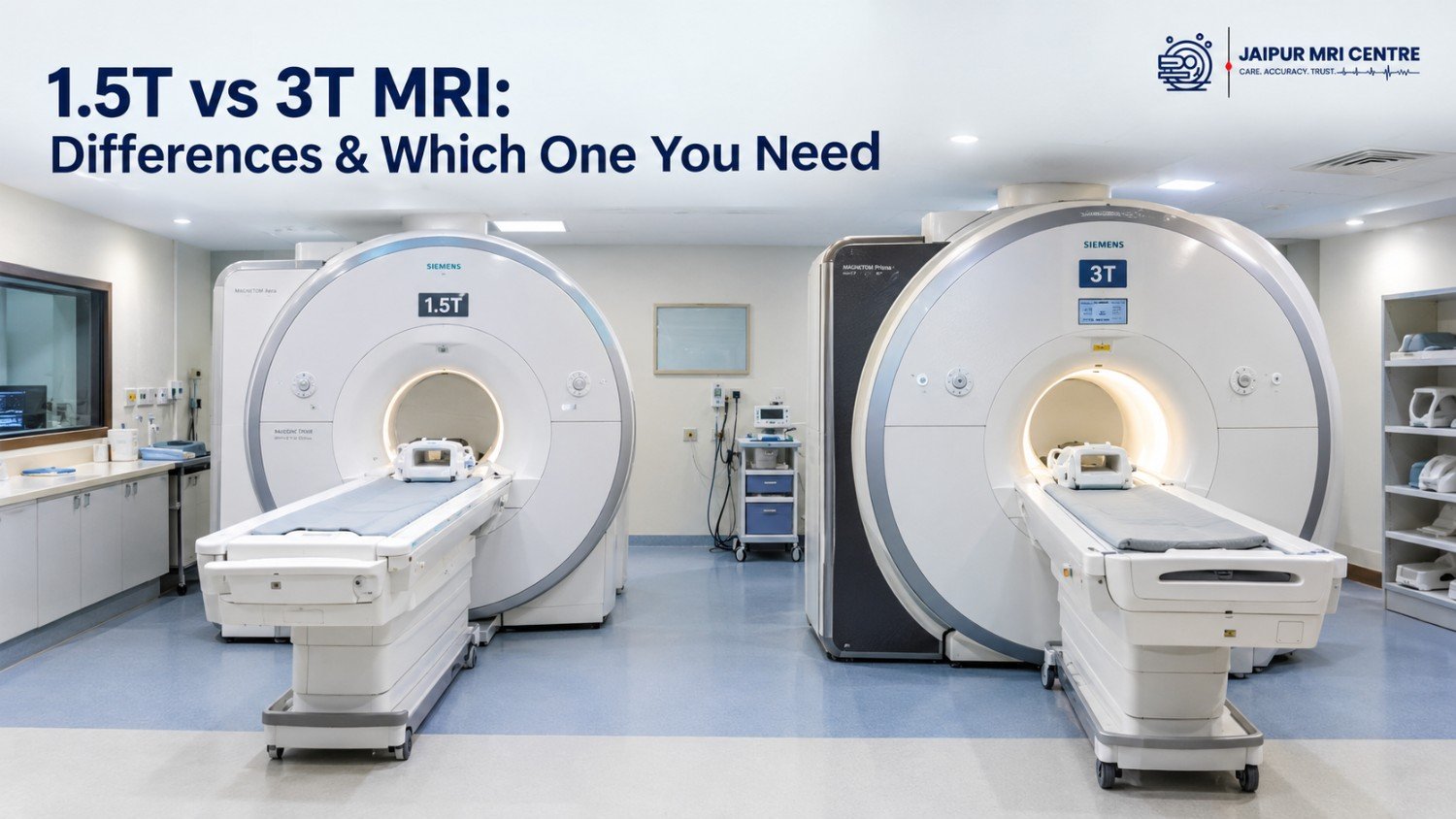
When your doctor prescribes a Magnetic Resonance Imaging (MRI) scan, you are suddenly faced with a series of technical choices. Among the most common questions patients encounter when booking their appointment is: “Should I get a 1.5T MRI or a 3.0T MRI?”
Understanding the distinctions between these two magnetic field strengths can feel intimidating. Do higher numbers always mean better results? Is a 3T machine always superior, or are there situations where a 1.5T MRI is actually the safer or preferred choice?
Demystifying the science behind Tesla strengths, comparing image quality, scanning speeds, clinical applications, comfort levels, and pricing can help you and your physician make an informed, confident decision. Let’s decode 1.5T vs 3T MRI!
To make comparisons between the two, it’s helpful to know what the “T” means.
Tesla is the unit used to measure the strength of the magnetic field inside the MRI scanner. It is named after Nikola Tesla, the engineer and inventor known for his work on electromagnetism. (He did not build the first MRI scanner. MRI was developed in the 1970s, and Paul Lauterbur and Peter Mansfield shared the 2003 Nobel Prize for their discoveries.) To put the numbers in perspective:
The stronger the magnet, the higher its signal-to-noise ratio (SNR), which is the ratio of the magnetic field’s signal strength to the background noise; the higher the hydrogen atoms’ signal-to-noise ratio (SNR), and the higher the resolution of the MRI images. But, greater strength comes with specific engineering and clinical challenges when comparing 1.5T and 3T.
The 1.5T MRI has been the standard for diagnostic imaging for decades. It has been clinically proven, is very versatile and can diagnose most medical conditions with extremely high accuracy. The main benefits of 1.5T MRI:
The 3.0T MRI is a high-field scanner with double the magnetic strength of the 1.5T scanner. The high field strength dramatically enhances the signal-to-noise ratio, enabling radiologists to see micro-anatomical detail that may be hard to see on standard machines. The advantages of 3.0T MRI are:
Did your doctor ask for a 3T MRI?
Tell us the body part and we will check which partner centres in Jaipur offer 3T. Your exact price is confirmed before you book.
When it comes to choosing between the two, patients often believe that 3.0T is better for all conditions. But which machine is actually apt for medical purposes is determined by medical necessity:
Consider 1.5T: Routine Spine checks (cervical, dorsal, lumbar), Routine Joint checks (knee, shoulder, ankle), abdominal scans, pelvic imaging, and patients with minor surgical hardware or metallic dental work.
Select 3.0T: Detailed brain analyses, neurodegenerative diseases, epilepsy mapping, prostate MRI (3T is often preferred, though 1.5T is also accepted) and high-performance sports medicine injuries.
Please remember to always follow your referring physician or radiologist’s protocol, as they know exactly what protocol will be required to answer your specific clinical question.
Many prescriptions only name the body part, for example “MRI knee” or “MRI brain”, and that is normal. If the machine strength is not mentioned, a 1.5T scan is usually enough for routine cases. If your doctor has specifically written 3T, tell us when you book so we can look for a partner centre that offers it. You can also ask your doctor or the radiologist whether 3T would add anything for your case.
You shouldn’t have to stress about your healthcare when dealing with technical details such as machine strength, prescription needs, and finding verified labs.
The Jaipur MRI Centre is an online appointment booking platform that connects patients with partner diagnostic centres in Jaipur and takes away the hassle of booking. If you were prescribed a routine 1.5T scan or a more advanced 3.0T high-field study, we make it easy for you. Book an appointment or ask us on WhatsApp at +91 7976031157.
To help visualize how these two systems compare across key clinical factors, review the comparison table below:
| Feature / Factor | 1.5 Tesla MRI | 3.0 Tesla MRI |
|---|---|---|
| Magnetic Field Strength | Standard high-field (~30,000x Earth) | Higher-field (~60,000x Earth) |
| Primary Strengths | General imaging, spine, bones, patients with metal implants | Brain, nerves, prostate, tiny joint structures, functional imaging |
| Image Resolution | High, excellent for routine clinical diagnosis | Extremely high, micro-anatomical detail |
| Metal Artifacts | Lower distortion near surgical implants | Higher susceptibility to distortion from metal |
| Scan Duration | Standard duration | Can be faster for specialized sequences |
| Patient Comfort | Standard bore size (wide-bore models exist at both strengths) | Slightly more warmth and louder noise; staying still is important at both |
| Cost / Affordability | More economical | Typically higher due to advanced technology |
1.5T and 3.0T MRI systems are amazing medical engineering achievements. The 1.5T scanner is an outstanding, very accurate scanning machine for most routine diagnostic needs, whereas the 3.0T scanner can provide breathtaking detail for neurological and complex joint cases.
Knowing about these differences will help you to make active choices about your health care.
Ready to book your MRI in Jaipur?
Share your doctor’s prescription or tell us the body part. Our team will confirm the partner centre, price and appointment time with you before your scan.
Jaipur MRI Centre is a healthcare appointment booking platform. Scans are performed at partner diagnostic centres.
The more powerful 3.0T MRI may be able to deliver more powerful signals and better image detail in some cases. This may be helpful to radiologists to evaluate small or subtle abnormalities. However, a higher magnetic field strength does not always mean better diagnostic accuracy.
The quality and usefulness of an MRI examination also rely on the imaging protocol, the patient’s cooperation in staying still, the expertise of the radiology team and the interpretation of the radiologist. A well-done 1.5T MRI can give enough information for many common scans to diagnose and plan treatment.
The objective is not just to select the most powerful magnet, but the proper images to be able to make a proper clinical diagnosis.
The selection of the right choice will depend on the area of examination and suspected condition.
1. Brain MRI: 3.0T MRI scanner may be beneficial for certain neurological procedures, including advanced imaging and subtle lesions. But 1.5T may also work well for many routine brain MRI studies.
2. Spine MRI: 1.5T and 3.0T also provide detailed images of the spine, discs, nerves and soft tissues around the spine. Depending on the indication and image quality needed, the best choice is to be determined.
3. MRI Of The Knee: Ligaments, menisci, cartilage and other joint structures are often evaluated in both field strengths. In some instances, a 3.0T scanner might offer more detail, but a good 1.5T scan can be effective as well.
4. Shoulder MRI: Both machines will be useful for assessing the soft tissues and tendons, as well as the muscles and ligaments of the shoulder. The selection will be related to the suspected injury and the imaging protocol.
The selection of the scanner should be based on the symptoms, medical history and diagnostic needs, not on the field strength.
Because of the stronger magnetic field, a 3.0T MRI scanner produces more signal, which can be used either to perform some imaging sequences faster or to capture better image resolution. This is not to say that all 3.0T scans will be quicker than the 1.5T exam.
The length of time will vary according to the part of the body to be scanned, the number and type of images that are being acquired, if there is a need for contrast media, and how still the patient can remain. If the initial images aren’t clear, additional images may be required for some examinations.
You should check with the diagnostic centre in Jaipur regarding the time of the scan, preparation and the use of contrast. The technologist’s directions can aid in acquiring useful images more efficiently.
When proper screening and safety protocols are done, both 1.5T and 3.0T MRI scanners are safe. MRI does not use ionising radiation. Patients should let imaging staff know if they have any medical devices or previous surgeries in place, or have metal fragments, pacemakers, cochlear implants or other devices that may be in the body, because the MRI machine has a very strong magnetic field.
Whether you can be scanned at 1.5T or 3.0T depends on the MRI machine and the manufacturer’s approved MR Conditional limits for your implant. The diagnostic centre should check the implant’s compatibility and adhere to the necessary safety measures prior to scanning. At 3T you may notice slightly more warmth and louder noise during the scan, and ear protection is provided.
If a contrast is being used, let the team know if the patient has kidney disease and/or any other relevant medical history. Also tell the team if you are or might be pregnant.
Disclaimer: This content is for general information only and is not medical advice. Please consult your doctor before any test or treatment.


Need Help